Home Blog

Stock Market Today (May 2026): S&P 500 Hits 7200, Nifty Near 24,000 – What’s Next?

While the Indian markets are taking a breather for Maharashtra Day, the global financial landscape is anything but quiet. If you fell asleep in March and woke up today, May 1, 2026, you’d be looking at a stock market that has defied gravity, skeptics, and traditional economic cycles.

From Wall Street’s historic “April Rush” to the strategic shifts in the Nifty 50, here is your comprehensive deep dive into the latest trending stock market news and what it means for your portfolio.

Wall Street’s Historic Month: The S&P 500 Breaches 7,200

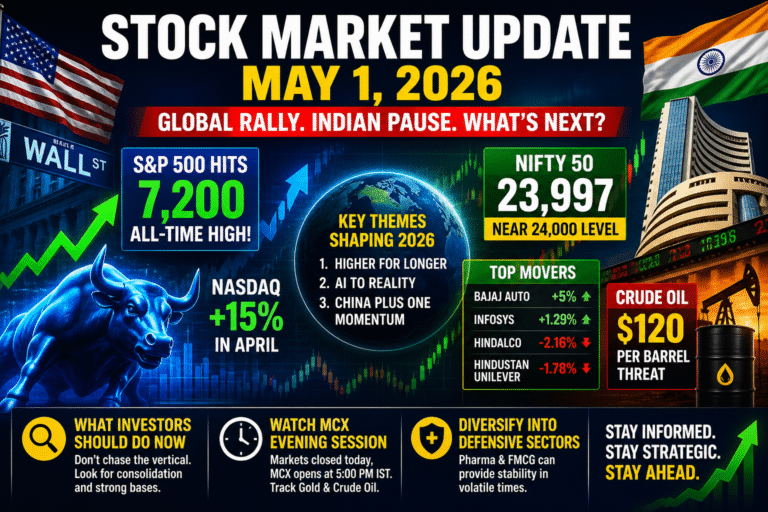
The biggest headline dominating the financial world right now is the sheer momentum of U.S. equities. On Thursday, the S&P 500 didn’t just climb; it sprinted past the 7,200 mark to close at an all-time high of 7,209.00.

This isn’t just a daily win. April 2026 will go down in the history books as the best monthly performance since 2020. The Nasdaq Composite followed suit, ending the month up a staggering 15%.

Why Is the U.S. Market Exploding?

Investors are currently fueled by a “Goldilocks” scenario:

  1. AI Monetization: We are no longer just talking about the potential of Artificial Intelligence. Companies like Alphabet (Google) are proving that AI is driving real revenue growth, pushing tech stocks to unprecedented valuations.
  2. Earnings Surprises: Roughly 80% of the S&P 500 companies that have reported this quarter have beaten analyst expectations.
  3. Yield Relief: The 10-year Treasury yield has finally cooled off to 4.38%. In the world of finance, when bond yields drop, stocks usually get their wings, as the cost of borrowing decreases and future earnings become more valuable.

Indian Markets: A Strategic Pause at 24,000

Back home, the Nifty 50 and Sensex are closed today, but the atmosphere remains electric. Before the holiday break, we saw some intense “tug-of-war” action between the bulls and the bears.

The Nifty 50 finished the last session at 23,997.55. It’s hovering right on the edge of that psychological 24,000 level. Historically, these round numbers act as “sticky” points—once the market decisively breaks and stays above 24,000, it often triggers a fresh wave of FOMO (Fear Of Missing Out) among retail investors.

The Winners and Losers

On the final trading day of April:

  • Auto Sector Strength: Bajaj Auto was the star of the show, surging over 5%. The demand for premium two-wheelers and a strong export outlook are keeping the auto sector in high gear.
  • IT Resilience: Despite global uncertainty, Infosys managed a healthy 1.29% gain, tracking the positive sentiment from US tech peers.
  • Pressure Points: It wasn’t all green. Metal and Banking stocks faced profit-booking. Hindalco and Hindustan Unilever saw significant selling pressure, reminding investors that inflation still bites into the margins of consumer goods and industrial materials.

The Oil Factor: The $120 Per Barrel Threat

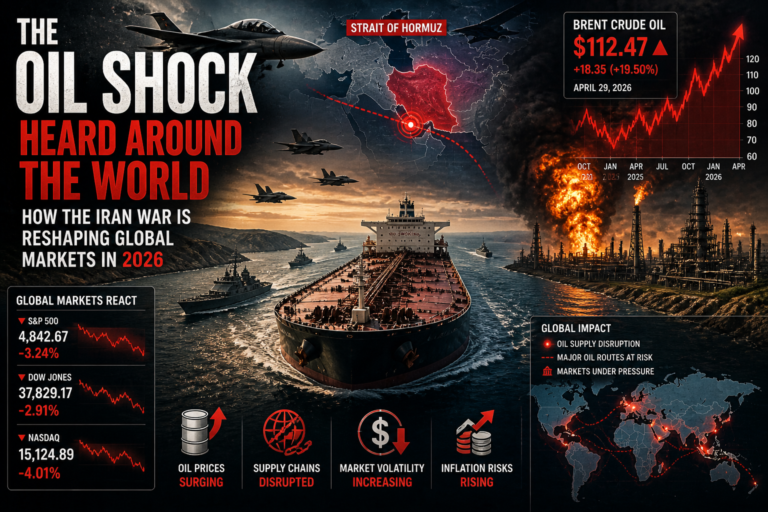
If there is a “ghost in the machine” right now, it is Crude Oil. Currently trending toward $120 per barrel, energy prices are the single biggest risk factor for the 2026 bull run.

For an import-dependent economy like India, high oil prices are a double-edged sword. While it benefits energy producers, it puts massive pressure on the Rupee and increases the input costs for almost everything—from the plastic in your phone to the vegetables in your kitchen. If oil stays above $115 for the next quarter, expect the Reserve Bank of India (RBI) to maintain its hawkish stance on interest rates.

Key Themes Shaping the Remainder of 2026

As we move into May, three major themes will dictate where the “smart money” flows.

1. The Federal Reserve and the “Higher for Longer” Reality

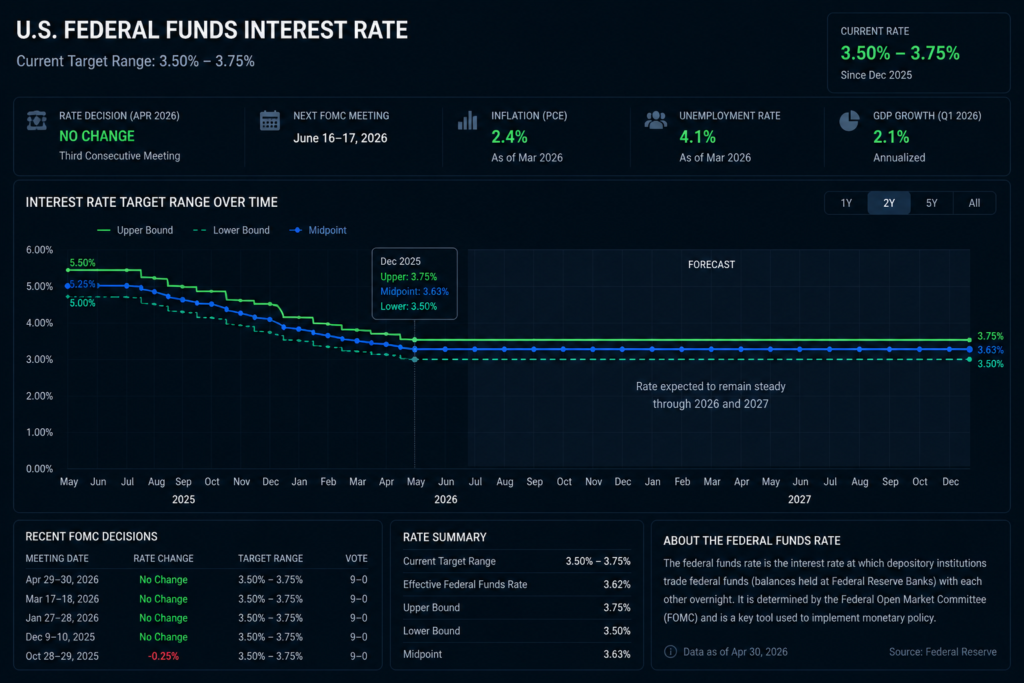
The hopes for aggressive rate cuts in early 2026 have largely evaporated. With U.S. inflation hovering stubbornly around 3%, the Fed is in no rush to lower rates. However, the market seems to have accepted this. The new narrative is: “We don’t need rate cuts as long as the economy is growing.” ### 2. The Shift from Hype to Reality in Tech

The “AI Bubble” talk has quieted down, replaced by “AI Integration.” Investors are now looking for companies that use AI to cut costs and improve efficiency, rather than just companies that have “AI” in their mission statement. Watch the Nasdaq 100 closely; it is the heartbeat of this movement.

3. The “China Plus One” Momentum in India

Global manufacturing continues to pivot toward India. This is reflected in the steady growth of mid-cap and small-cap industrial stocks. While the large-caps (Sensex/Nifty) get the headlines, the real wealth creation in 2026 is happening in the manufacturing and infrastructure sectors.


What Should Investors Do Now?

With the markets at record highs, it’s easy to feel either invincible or terrified. Here’s a “Pro” approach to the current volatility:

  • Don’t Chase the Vertical: When a stock moves up in a straight line (like some of the recent tech gainers), the risk of a “mean reversion” (a price correction) increases. Look for stocks that are consolidating or building a “base.”
  • Watch the Evening MCX Session: Even though the stock market is closed today, the Commodity Market (MCX) opens at 5:00 PM IST. Keep an eye on Gold and Crude Oil prices tonight; they often provide a “preview” of how the stock market will open on Monday morning.
  • Diversify into Defensive Sectors: If you are heavy on Tech and Growth, consider balancing your portfolio with “defensive” plays like Pharma. Sun Pharma showed strength even when the broader market dipped, proving its value as a hedge.

Final Thoughts

The stock market in May 2026 is a tale of two worlds. On one side, we have record-breaking innovation and corporate profits driving Wall Street to the moon. On the other, we have the sobering reality of $120 oil and “sticky” inflation.

For the Indian investor, the upcoming week will be crucial. Breaking past 24,000 on the Nifty could set the stage for a summer rally. But as always, the key to winning in this market isn’t timing the top—it’s time in the market with a diversified, disciplined strategy.

Disclaimer: The information provided in this blog is for educational purposes only and does not constitute financial advice. Always consult with a certified financial advisor before making investment decisions.


Quick Market Summary Table (May 1, 2026)

IndexCurrent LevelTrendStatus
S&P 5007,209.00📈 All-Time HighOpen (Global)
Nifty 5023,997.55↔️ ConsolidatingClosed (Holiday)
Sensex76,913.50↔️ ConsolidatingClosed (Holiday)
Nasdaq24,892.31🚀 Strong BullishOpen (Global)
Brent Crude~$118.50⚠️ High RiskActive

Stay tuned for Monday’s opening bell, where we will see if the Nifty can finally conquer the 24,000 peak!

How are you positioning your portfolio for the rest of May? Are you betting on a tech continuation or a pivot to commodities?

Palantir Slides 17% in Just Days: What’s Driving the Sudden Selloff in the AI Giant?

0

Palantir Technologies has faced a sharp and unexpected selloff, with its stock dropping nearly 17% over just a few trading sessions. Once considered one of the strongest players in enterprise AI, the company is now under pressure as investors reassess its long-term position in a rapidly evolving market.

A Rapid Decline That Shook Investors

The recent downturn unfolded quickly. Palantir’s stock, which was trading above $150 earlier this month, has now fallen to nearly $124. The decline accelerated over consecutive trading days, signaling growing concern among investors rather than a one-off correction.

This drop has significantly impacted the company’s overall performance in 2026, with the stock now down around 30% since the start of the year. For a company that entered the year with strong momentum, this reversal has raised serious questions about valuation and future growth.

Strong Financials, But Rising Doubts

Interestingly, the selloff is not driven by weak earnings. Palantir recently reported impressive financial results for Q4 2025, with revenue growing 70% year-over-year to over $1.4 billion. Its U.S. commercial segment showed even stronger momentum, surging by 137%.

Despite these strong fundamentals, investors are becoming cautious. One major concern is Palantir’s high valuation, with its price-to-earnings ratio reflecting extremely optimistic expectations. When a stock is priced for perfection, even small doubts can trigger large corrections.

The Trigger: AI Competition Concerns

The immediate catalyst behind the selloff appears to be comments from well-known investor Michael Burry. He suggested that AI company Anthropic could be gaining an edge in enterprise adoption, potentially challenging Palantir’s position.

Although the comment was later removed, it spread quickly and influenced market sentiment. Investors began questioning whether new AI solutions, particularly those offering more autonomous capabilities, could reduce the need for platforms like Palantir.

The concern is not that Palantir will be replaced overnight, but that the structure of enterprise AI spending could shift. Companies may increasingly rely directly on advanced AI models instead of using intermediary platforms.

A Broader Impact Across AI Stocks

The impact of this narrative has not been limited to Palantir. Other enterprise software and AI-related companies have also experienced selling pressure. This suggests that the market may be undergoing a broader reassessment of how value will be distributed in the AI ecosystem.

Investors are beginning to differentiate between companies that build AI models and those that provide platforms around them. This shift could have long-term implications for the entire sector.

What It Means for the Future

Palantir remains a key player in the AI and data analytics space, with strong government and commercial contracts. However, the recent selloff highlights how sensitive high-growth tech stocks are to changes in narrative and sentiment.

Going forward, the company’s ability to adapt to evolving AI trends will be critical. Investors will be watching closely to see whether Palantir can maintain its relevance as competition intensifies.

Final Thoughts

The recent drop in Palantir’s stock is a reminder that even the strongest companies are not immune to market sentiment. While the fundamentals remain solid, shifting expectations around AI competition have introduced new uncertainty.

For investors, this moment represents both a warning and an opportunity. The key question now is whether this is a temporary correction—or the beginning of a deeper shift in the AI landscape.

Israel Signals Talks with Lebanon Amid Fragile Ceasefire and Rising Hormuz Tensions

A delicate geopolitical situation continues to unfold in the Middle East as Israel has agreed to initiate negotiations with Lebanon, marking a potentially significant shift in regional dynamics. The announcement comes at a time when a fragile ceasefire between the United States and Iran remains under strain, and tensions surrounding the strategically vital Strait of Hormuz continue to raise global concerns.

A Narrow Diplomatic Window Opens

The recent two-week truce between the United States and Iran, reportedly brokered by Pakistan, has created a limited but crucial opportunity for diplomacy. While the agreement has temporarily reduced direct hostilities, it remains far from stable. Both sides have unresolved demands, and mutual accusations of ceasefire violations continue to cast doubt over its sustainability.

Initial signs suggested cautious optimism. Gulf nations reported a noticeable decline in Iranian missile and drone activity following an intense wave of strikes earlier in the week. Within 20 to 24 hours after the initial escalation, regional airspace appeared relatively calm. Notably, no threats were recorded against Israel after the early hours of April 8.

Market analysts and global investors reacted positively to the ceasefire development. According to strategists at Deutsche Bank, the mere existence of an agreement—even one surrounded by uncertainty—helped boost confidence and provided a clearer outlook toward potential de-escalation.

Israel-Lebanon Negotiations Gain Momentum

In a significant development, Israeli Prime Minister Benjamin Netanyahu confirmed that Israel is prepared to enter direct negotiations with Lebanon. This move follows repeated requests from Lebanese authorities to initiate dialogue.

Netanyahu stated that the discussions would primarily focus on two critical objectives: the disarmament of Hezbollah and the establishment of peaceful relations between the two neighboring nations. He also acknowledged Lebanon’s internal calls for demilitarization, particularly in Beirut, signaling a possible alignment of interests.

However, this diplomatic gesture comes amid continued Israeli military actions against Hezbollah targets in Lebanon. These strikes have drawn sharp criticism from Iran, which labeled them as violations of the ceasefire and questioned the legitimacy of ongoing negotiations under such conditions.

Pakistan Emerges as a Key Mediator

All attention is now shifting toward Islamabad, where high-stakes talks are scheduled to take place over the weekend. Pakistan has positioned itself as a central mediator in the conflict, facilitating dialogue between key stakeholders.

Iranian negotiators are expected to arrive in Pakistan, led by senior diplomatic representatives. Meanwhile, the United States delegation will be headed by Vice President JD Vance, accompanied by prominent advisers including Jared Kushner and Steve Witkoff. The first round of formal discussions is set to begin on Saturday.

Pakistan has strongly condemned Israel’s recent military actions in Lebanon, warning that such moves threaten not only regional stability but also broader global peace efforts. Several European nations, including France and Italy, have echoed similar concerns, calling for restraint and renewed commitment to diplomatic solutions.

Strait of Hormuz: A Global Flashpoint

While diplomatic efforts continue, tensions around the Strait of Hormuz remain a major point of concern. This narrow waterway is one of the most critical النفط shipping routes in the world, handling a significant portion of global energy supplies.

Iran has indicated that maritime traffic through the strait may resume, but only under strict conditions. Officials in Tehran have tied safe passage to changes in U.S. military posture and a halt to Israeli operations in Lebanon. They emphasized that any reopening of the strait would adhere to international law, but only if their conditions are met.

In the meantime, Iran has tightened its control over the region. The Iranian navy has issued warnings to commercial vessels, urging them to coordinate closely with military authorities and follow designated routes due to potential risks, including naval mines.

Shipping data highlights the scale of disruption. Vessel movement through the strait has dropped significantly, with only a limited number of ships operating with active tracking systems. A considerable portion of ongoing activity involves so-called “dark fleet” tankers, which operate without tracking devices and are often associated with sanctioned oil transport.

Economic Implications and Global Reactions

The uncertainty surrounding the Strait of Hormuz has sparked concerns among global leaders and economists. Any prolonged disruption could have far-reaching economic consequences, particularly in energy markets.

Italian Prime Minister Giorgia Meloni warned that additional restrictions imposed by Iran could lead to unpredictable economic outcomes. She emphasized the importance of maintaining freedom of navigation and preventing further escalation that could destabilize global trade.

The situation has also placed pressure on international oil prices, shipping costs, and supply chains. Analysts warn that even temporary disruptions could trigger volatility across financial markets.

U.S. Maintains Military Presence

Amid ongoing negotiations, U.S. President Donald Trump has taken a firm stance on military engagement in the region. He հայտարարել that American forces will remain deployed around Iran until a comprehensive and binding agreement is reached.

In a recent statement, Trump reiterated his core demands: a complete halt to Iran’s nuclear weapons ambitions and the reopening of the Strait of Hormuz for safe and unrestricted navigation. He claimed that such an agreement had been previously understood but remains unfulfilled.

Trump also issued a warning that failure to reach a deal could lead to renewed military conflict, although he expressed confidence that such a scenario is unlikely.

The United States has significantly increased its military presence in the Middle East in recent months. This includes the deployment of two aircraft carrier strike groups and approximately 50,000 troops, marking the largest buildup in the region since 2003.

Persistent Challenges to Peace

Despite diplomatic efforts, several obstacles continue to hinder progress. Iran has accused both the United States and Israel of violating the terms of the ceasefire shortly after it was established. Tehran has also insisted that any comprehensive agreement must include Lebanon, complicating the negotiation framework.

Additionally, Iran has resisted U.S. demands to halt its uranium enrichment program, a longstanding point of contention that remains central to the conflict.

Meanwhile, Israel maintains that its military operations in Lebanon are separate from the U.S.-Iran ceasefire, further complicating efforts to achieve a unified resolution.

The Road Ahead

As negotiations prepare to begin in Pakistan, the international community remains cautiously hopeful yet deeply aware of the challenges ahead. The coming days are expected to be critical in determining whether the current ceasefire can evolve into a more durable peace agreement.

Much will depend on the willingness of all parties to compromise and address core issues, including security concerns, regional influence, and economic stability.

For now, the Middle East stands at a crossroads—caught between the promise of diplomacy and the خطر of renewed conflict. The outcome of the upcoming talks could shape not only regional dynamics but also global economic and political landscapes for months, if not years, to come.

Trump Announces Temporary Ceasefire Proposal with Iran Amid High-Stakes Middle East Tensions

Introduction

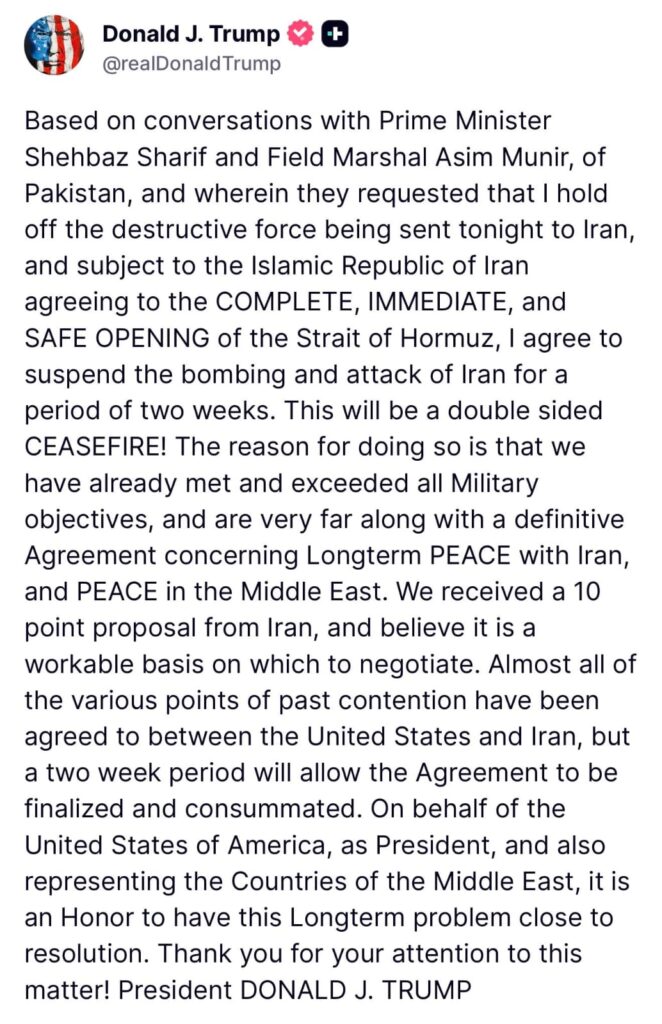
In a surprising development that could reshape geopolitical dynamics, former U.S. President Donald J. Trump has announced a proposed temporary ceasefire involving Iran. The statement, reportedly based on discussions with Pakistani leadership, suggests a pause in military actions for two weeks, creating a potential window for long-term peace negotiations. At a time when global tensions remain high, this announcement has quickly drawn attention from policymakers, investors, and international observers alike. The proposal also touches on the strategic importance of the Strait of Hormuz, a critical global oil route, making this not just a political story but an economic one as well.


Background: Rising Tensions and Strategic Importance of the Middle East

The Middle East has long been a focal point of global geopolitical tensions, particularly involving the United States and Iran. Over the years, disputes over nuclear programs, regional influence, and military actions have created a fragile environment prone to sudden escalations.

One of the most sensitive flashpoints in this region is the Strait of Hormuz, through which nearly a fifth of the world’s oil supply passes. Any disruption in this narrow waterway can trigger global economic instability, affecting oil prices, stock markets, and international trade.

In recent weeks, tensions reportedly escalated to a point where military action appeared imminent. However, diplomatic backchannel communications involving Pakistan’s Prime Minister Shehbaz Sharif and Army Chief Asim Munir seem to have played a key role in de-escalation efforts.

This latest ceasefire proposal signals a possible shift from confrontation toward negotiation, offering a rare moment of cautious optimism.


Key Developments: Inside the Ceasefire Proposal

According to the statement shared publicly, the proposed agreement involves a two-week suspension of military operations against Iran, conditional upon Iran agreeing to ensure the complete and safe reopening of the Strait of Hormuz.

The announcement highlights several critical points:

  • The ceasefire is described as “double-sided,” indicating mutual restraint.
  • The U.S. claims to have already achieved key military objectives.
  • A 10-point proposal from Iran is reportedly under consideration as a basis for negotiations.
  • The two-week pause is intended to finalize a long-term peace agreement.

What makes this development particularly notable is the tone of the message. Rather than emphasizing conflict, the statement focuses on resolution, negotiation, and long-term stability in the Middle East.

This shift in tone could signal a broader strategic recalibration, especially if both sides are genuinely willing to engage in meaningful dialogue.


Global Reactions: Mixed Signals from Political and Market Circles

The announcement has triggered a wide range of reactions across political and economic spheres. While some analysts view it as a positive step toward de-escalation, others remain cautious, citing the complexity of U.S.-Iran relations.

In diplomatic circles, the involvement of Pakistan is being seen as a significant factor. Pakistan has historically maintained relationships with both Western and regional powers, making it a potential mediator in sensitive negotiations.

Meanwhile, global markets are closely monitoring the situation. Any signs of stability in the Middle East tend to ease concerns around oil supply disruptions. This, in turn, can influence inflation expectations and investor sentiment across major economies.

However, uncertainty still lingers. The success of the ceasefire depends heavily on whether both parties adhere to the proposed terms and whether negotiations can progress within the limited timeframe.


Strategic Analysis: What This Means for Geopolitics and Economy

From a geopolitical perspective, this ceasefire proposal could mark a turning point—if it leads to sustained dialogue. The emphasis on reopening the Strait of Hormuz suggests that economic considerations are playing a central role in decision-making.

For the United States, stabilizing the region aligns with broader strategic goals, including maintaining global energy security and reducing military engagement abroad.

For Iran, agreeing to such terms could help ease international pressure and open pathways for economic recovery.

Economically, the implications are significant:

  • Oil Markets: Stability in the Strait of Hormuz could prevent sharp spikes in oil prices.
  • Stock Markets: Reduced geopolitical risk often supports bullish sentiment.
  • Global Trade: Safe shipping routes ensure smoother international commerce.

However, the situation remains fluid. Markets are known to react quickly to geopolitical developments, and any deviation from the proposed plan could reverse current optimism.


Challenges and Risks

Despite the positive tone, several challenges could hinder progress:

  • Trust Deficit: Decades of conflict have created deep mistrust between the U.S. and Iran.
  • Short Timeline: Two weeks may not be sufficient to finalize a comprehensive agreement.
  • External Influences: Other regional players could impact negotiations.
  • Verification Issues: Ensuring compliance on both sides remains a key concern.

These factors highlight that while the proposal is promising, it is far from guaranteed success.


Future Outlook: A Step Toward Peace or Temporary Pause?

Looking ahead, the next two weeks will be critical. If negotiations progress smoothly, this could lead to a broader peace framework that stabilizes the region for years to come.

Possible Scenarios:

Optimistic Scenario:
Both sides adhere to the ceasefire, finalize agreements, and establish long-term peace.

Neutral Scenario:
The ceasefire holds temporarily, but negotiations extend beyond the initial timeframe.

Pessimistic Scenario:
Talks collapse, leading to renewed tensions or even escalation.

At this stage, the global community remains watchful but hopeful. The outcome will depend on diplomacy, mutual trust, and the willingness to compromise.


Conclusion

The ceasefire proposal announced by Donald J. Trump represents a significant moment in ongoing Middle East tensions. While uncertainties remain, the shift toward dialogue and negotiation offers a glimmer of hope in an otherwise volatile landscape.

For global markets, policymakers, and everyday citizens, the stakes are high. A successful agreement could bring not only political stability but also economic relief across regions.

As the situation unfolds, one thing is clear—the world will be watching closely.


Disclaimer

This article is based on publicly available information and statements. It is intended for informational purposes only and does not represent official policy positions or verified diplomatic outcomes.

Dow Jones Near Key Support: Will DJIA Recover or Face Another Breakdown in 2026?

0

Introduction

The Dow Jones Industrial Average (DJIA) is once again at a crucial crossroads, and traders are watching every move closely. After a sharp decline from recent highs, the index is now attempting a recovery near critical support levels. But the big question remains—Is this the beginning of a new stock market rally, or just a temporary bounce before another fall?

This moment is important because it reflects the broader sentiment of the US stock market. With volatility rising and technical indicators flashing mixed signals, investors are trying to decode what comes next. In this article, we analyze the latest Dow Jones chart, key technical levels, and the overall market outlook.

Background: Why Dow Jones Is Facing Pressure After Recent Highs

The Dow Jones has experienced a strong upward trend over the past months, reaching near the 50,000 mark before facing resistance. Historically, such psychological levels often act as strong barriers where profit booking begins.

Looking at past trends, the DJIA tends to move in cycles—rallies followed by consolidation or correction. The recent decline from highs suggests that the market entered a correction phase, driven by selling pressure and cautious investor sentiment.

From a broader perspective, corrections are healthy for the market. They allow overvalued stocks to stabilize and create new entry opportunities. However, the current correction appears sharper than usual, indicating stronger selling momentum.

The index is now attempting to stabilize near support zones, which could determine the next big move. If buyers regain control, the Dow could recover. If not, further downside may follow.

Key Data & Statistics

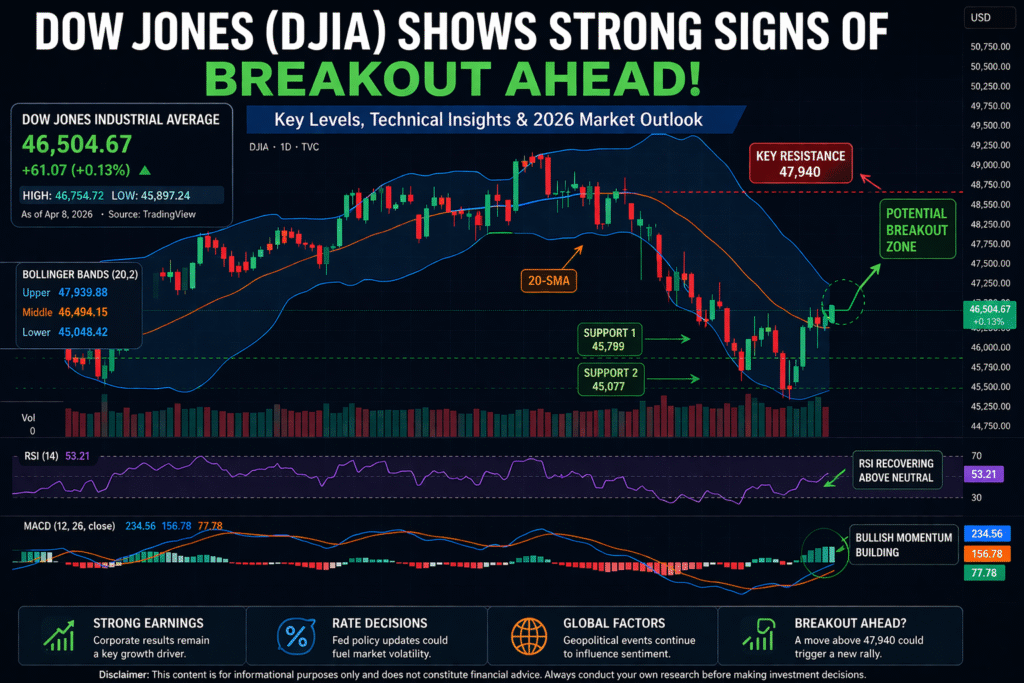
  • Current Price: Around 46,500 level
  • Recent High: Near 50,000 resistance zone
  • Key Resistance: 47,900 – 48,000 range
  • Immediate Support: 45,700
  • Strong Support: 45,000 – 45,100 zone
  • Bollinger Bands: Price near lower band, indicating oversold conditions
  • Trend: Short-term bearish, long-term still neutral

Dow Jones chart showing sharp correction, key support zones, and Bollinger Band positioning.

Current Market Developments: Why Dow Jones Is Volatile Right Now

The recent movement in the Dow Jones reflects uncertainty in the broader financial markets. After hitting highs, the index faced continuous selling pressure, forming a clear downtrend visible in the chart.

One of the most noticeable developments is the formation of consecutive red candles, showing strong bearish momentum. This indicates that sellers dominated the market for several sessions.

However, the latest candles suggest a possible recovery attempt. The index bounced from the 45,000 zone, which is acting as a strong support level. This indicates that buyers are stepping in at lower levels.

Another important observation is that the price is still trading below the moving average (blue line), which signals that the overall trend remains weak in the short term.

Market participants are currently cautious. Traders are waiting for confirmation before taking positions, while long-term investors are watching support levels for potential accumulation.

This phase of uncertainty often leads to sharp moves once a clear direction is established.

Technical & Fundamental Analysis: What the Chart Is Telling Us

The chart provides several important insights into the current state of the Dow Jones.

First, the Bollinger Bands show that the price recently touched the lower band. This usually indicates that the market is in an oversold condition. Such situations often lead to short-term rebounds.

Second, the moving average line is sloping downward, confirming bearish momentum. As long as the price remains below this level, upward moves may face resistance.

Third, the resistance zone around 47,900 is critical. The chart clearly shows that previous attempts to move higher were rejected near this level. This makes it a strong barrier for any bullish breakout.

On the downside, the 45,000 level is acting as a major support. The recent bounce from this area suggests that buyers are defending this zone aggressively.

From a technical standpoint, three scenarios emerge:

If the price breaks above 47,900 with strong volume, it could signal a bullish reversal and trigger a stock market rally.

If the price fails to cross resistance and falls below 45,000, it could lead to further downside, possibly testing lower levels.

If the price stays between these levels, the market may continue consolidating.

Fundamentally, the market is influenced by interest rate expectations, inflation concerns, and global economic conditions. These factors are adding to the uncertainty.

Risks and Challenges

  • Strong resistance preventing upward movement
  • Possibility of breakdown below key support
  • High market volatility
  • Uncertain global economic environment
  • False recovery signals trapping traders

Expert Opinions & Market Sentiment

Market sentiment currently appears mixed. Short-term traders are cautious due to the recent downtrend, while long-term investors are looking for buying opportunities near support.

Institutional investors often wait for confirmation before entering the market. This is why volumes tend to increase near breakout or breakdown points.

There is also a noticeable shift toward defensive strategies. Investors are focusing more on risk management rather than aggressive buying.

Overall sentiment can be described as “wait and watch.” The market is not clearly bullish or bearish at this stage, making it a tricky environment for traders.

Future Outlook: What Traders Should Expect Next

Bullish Scenario
If the Dow Jones breaks above the 47,900 resistance level, it could attract strong buying interest. This may push the index toward higher levels and potentially restart the upward trend.

Bearish Scenario
If the price drops below 45,000, it could trigger panic selling. This may lead to a deeper correction and increase market volatility.

Neutral Scenario
If the index continues to trade between 45,000 and 47,900, the market may remain range-bound. This phase could continue until a strong trigger appears.

Overall, the market outlook remains uncertain but full of opportunities for those who understand key levels.

Conclusion: A Decisive Moment for Dow Jones

The Dow Jones is currently in a critical phase where both risk and opportunity exist. The chart clearly shows a battle between buyers and sellers at key levels.

For traders, this is a time to stay disciplined and follow technical signals closely. For investors, it may be a good opportunity to observe and plan rather than rush into decisions.

The next move will likely depend on whether the index breaks resistance or support. Until then, patience and careful analysis remain the best strategies.

If you found this analysis helpful, consider sharing it and exploring more insights on stock market trends and trading strategies.

Disclaimer

This article is for informational purposes only and should not be considered financial advice. Always do your own research before making any investment decisions.

Read more Articles Hindalco Industries in Spotlight: Is the Aluminium Cycle Turning in Its Favor?

Hindalco Industries in Spotlight: Is the Aluminium Cycle Turning in Its Favor?

0

Introduction: A Move That Signals More Than Just Momentum

In a market where leadership shifts quietly before it becomes obvious, Hindalco Industries Limited has started to draw attention again. The stock’s recent upward movement is not just another daily fluctuation—it reflects a deeper alignment of global commodity trends, domestic demand, and investor positioning.

At a time when the Indian stock market news cycle is dominated by selective buying and sector rotation, Hindalco’s price action stands out. The move suggests that investors are beginning to re-evaluate metal stocks, especially those with strong global linkages and downstream integration.

This development matters now because metals, historically, tend to lead early phases of economic recovery or inflation-driven cycles. If that pattern holds, Hindalco’s current momentum could be more than a short-term spike.

Market Overview: Selective Strength in a Cautious Market

The broader market environment remains mixed, with benchmark indices such as the Nifty and Sensex showing intermittent volatility. However, beneath the surface, there is clear evidence of sector-specific strength, particularly in metals and select PSU counters.

Metal stocks have benefited from improving global cues, including firmer commodity prices and supply-side uncertainties. Energy stocks have followed closely, supported by stable crude oil trends. Meanwhile, defensive sectors such as defense manufacturing continue to attract long-term investors, though with relatively muted short-term movement.

Within this context, Hindalco has emerged among the top gainers today, reflecting both sectoral momentum and stock-specific triggers.

Hindalco Industries: Understanding the Business Strength

Hindalco https://www.nseindia.com/get-quote/equity/HINDALCO/Hindalco-Industries-LimitedIndustries Limited, part of the Aditya Birla Group, is not just a domestic aluminium producer—it is a globally integrated metals company with a strong presence across the value chain.

The company operates in:

  • Aluminium production and downstream products
  • Copper manufacturing
  • Global rolled products through its subsidiary Novelis

Novelis, in particular, gives Hindalco a unique advantage. It connects the company directly to global demand trends in packaging, automotive, and recycling—areas that are seeing structural growth.

This diversified model reduces dependence on pure commodity pricing and provides relatively stable earnings visibility compared to many peers.

What’s Driving the Recent Move in Hindalco Share Price

The recent rise in Hindalco share price can be traced to a combination of global and domestic factors that are aligning in its favor.

Global Aluminium Trends

Aluminium prices have shown resilience in recent weeks, supported by:

  • Supply constraints in key producing regions
  • Rising energy costs impacting smelting capacity
  • Sustained demand from infrastructure and transportation sectors

For a company like Hindalco, which operates across upstream and downstream segments, this translates into better pricing power and improved margins.

Demand from Emerging Sectors

The demand narrative for aluminium is evolving. It is no longer limited to traditional construction or industrial use.

Key growth areas include:

  • Electric vehicles, where aluminium is preferred for lightweight structures
  • Renewable energy infrastructure
  • Sustainable packaging solutions

Through Novelis, Hindalco is deeply embedded in these segments, positioning it well for long-term growth.

Macroeconomic and Geopolitical Factors

Global uncertainties, including geopolitical tensions and supply chain disruptions, have added another layer of complexity to commodity markets.

While such factors introduce volatility, they also tend to support prices in the short term by tightening supply. Investors often respond by increasing exposure to metal stocks, especially those with global reach.

Volume and Trade Activity: Reading the Signals

One of the most telling aspects of Hindalco’s recent move is the rise in trading volumes.

Elevated volumes typically indicate:

  • Institutional participation rather than retail-driven buying
  • Accumulation phases where large investors build positions
  • Increased conviction about future price direction

When price appreciation is accompanied by strong volume, it often suggests that the move has underlying strength rather than being purely speculative.

Expert Perspective: Opportunity with a Note of Caution

Market participants are viewing Hindalco with a mix of optimism and measured caution.

On the positive side, analysts point to:

  • Strong global demand outlook for aluminium
  • Integrated business model providing resilience
  • Improving balance sheet and operational efficiency

However, experienced market observers also highlight key risks.

Metal stocks are inherently cyclical. A reversal in global commodity prices can quickly impact profitability. Additionally, factors such as currency fluctuations, energy costs, and global economic slowdown can influence performance.

The consensus view appears to be that while the structural story remains intact, investors should be mindful of cyclical volatility.

Sector Comparison: Metals Regain Leadership

When comparing sectors, metals are currently showing relative strength.

  • Metals: Benefiting from global price trends and demand recovery
  • Energy: Supported by stable crude prices but dependent on global cues
  • Defense: Strong long-term growth visibility but slower near-term momentum

Within this framework, Hindalco stands out due to its global exposure and downstream integration, making it more than just a cyclical play.

Financial Position: Stability with Growth Potential

Hindalco’s financial performance has been supported by both domestic operations and its international business.

Key observations include:

  • Consistent revenue generation driven by diversified segments
  • Margin stability supported by value-added products
  • Strong contribution from Novelis, which provides earnings visibility

Compared to pure commodity players, Hindalco’s financial structure offers a more balanced risk-reward profile.

Investor Strategy: Navigating the Opportunity

For investors evaluating Hindalco Industries Limited, the approach depends on investment horizon and risk appetite.

Short-Term Perspective

In the near term, the stock may continue to benefit from:

  • Positive global commodity trends
  • Sectoral momentum in metals
  • Institutional buying interest

However, short-term movements can be volatile, especially if global cues change.

Long-Term Perspective

From a longer-term standpoint, the company’s positioning in:

  • Sustainable materials
  • EV supply chains
  • Global recycling markets

provides a compelling growth narrative.

Investors with a long-term horizon may find value in gradual accumulation, particularly during market corrections.

Key Risks to Watch

  • Sudden decline in global aluminium prices
  • Macroeconomic slowdown affecting demand
  • Rising input and energy costs
  • Currency volatility impacting export realizations

A balanced approach, rather than aggressive positioning, remains prudent.

Closing Insight: A Stock Reflecting a Larger Shift

The recent movement in Hindalco share price is not happening in isolation. It reflects a broader shift in how investors are viewing commodity-linked businesses in the current environment.

As global dynamics evolve, companies that combine scale, integration, and exposure to future demand trends are likely to remain in focus. Hindalco fits that profile, but like all metal stocks, it sits at the intersection of opportunity and cyclicality.

For now, the market appears to be leaning toward the opportunity side.

READ MORE Aluminium Stocks Surge as Middle East Crisis Shakes Global Supply: Is This the Start of a New Metal Supercycle?

Aluminium Stocks Surge as Middle East Crisis Shakes Global Supply: Is This the Start of a New Metal Supercycle?

0

While the broader market on Dalal Street felt like a bloodbath this Monday, a surprising pocket of resilience emerged in the metals space. As the BSE Sensex plummeted over 1.2%, nearly wiping out 1,000 points in early trade, aluminium stocks like Hindalco Industries, National Aluminium Company (NALCO), and Vedanta decoupled from the benchmark to post staggering gains.

The trigger wasn’t a domestic policy shift or a surprise earnings beat. Instead, the “shining” performance was fueled by fire and smoke in the Middle East. Over the weekend, reports surfaced of missile and drone strikes hitting major production hubs in the Gulf, sending the London Metal Exchange (LME) into a frenzy. For Indian investors, this isn’t just another day of volatility; it’s a fundamental shift in the global supply-demand equation that could redefine the sector’s outlook for 2026.

The Global Supply Shock: Why Aluminium is Catching Fire

The primary catalyst for this sudden rally is a massive supply disruption in the Gulf region, which accounts for roughly 9% of the world’s aluminium supply. Tensions between the US, Israel, and Iran reached a breaking point following strikes that resulted in significant damage to two of the world’s most critical smelting facilities: Aluminium Bahrain (Alba) and Emirates Global Aluminium (EGA).

Alba, which operates the world’s largest single-site smelter, confirmed it is currently assessing damage from Iranian strikes. Meanwhile, EGA reported its plant sustained “significant damage”. The result? Benchmark three-month aluminium on the LME jumped 6% to hit near four-year highs, trading at roughly $3,492 per metric tonne.

Compounding the facility damage is the growing “chokehold” on the Strait of Hormuz. This critical shipping lane is now fraught with uncertainty, making it nearly impossible for producers in the region to move material to global markets. When you combine physical plant damage with a logistical nightmare, you get a classic supply-side shock.

Stock Overview: The Titans of Indian Metal

To understand why Indian players are the biggest beneficiaries, we have to look at their market positioning.

  1. Hindalco Industries: A flagship of the Aditya Birla Group, Hindalco is a global powerhouse, particularly through its subsidiary Novelis. While it has seen a 4.46% decline over the past month due to general market weakness, its long-term trajectory remains formidable, with a 10-year return of over 920%.
  2. NALCO: As a state-owned enterprise (PSU), NALCO is one of the lowest-cost producers of alumina and aluminium globally. Its integrated operations give it a massive cushion when global prices spike.
  3. Vedanta: Anil Agarwal’s diversified natural resources giant has been in the news for its potential demerger, but today, its aluminium segment is the star of the show, benefiting directly from the LME price surge.

Market Reaction: Defying the Sensex Slump

The intraday price action on March 30, 2026, was nothing short of dramatic. While the Nifty 50 struggled to hold the 22,500 mark, the Nifty Metal index was the only sectoral index trading in the green.

  • NALCO emerged as the leader, surging over 6% to trade near Rs 395.
  • Hindalco Industries bucked the trend of its large-cap peers, rallying 5% to hit an intraday high of approximately Rs 913.
  • Vedanta wasn’t far behind, gaining around 5% to reach Rs 679 per share.

Investors are clearly rotating capital out of high-beta sectors and into “commodity plays” that offer a hedge against geopolitical instability. The volume activity in these counters was significantly higher than their 20-day averages, suggesting that institutional “big fish” are moving back into the metal space.

Expert Insights: The Bull vs. Bear Debate

The current rally has split the analyst community. Some see this as a temporary “war bounce,” while others believe a structural supply deficit is forming.

The Bull Case: Many seasoned analysts point out that even if the conflict eases, restoring damaged infrastructure in the Middle East won’t happen overnight. “You don’t just flip a switch on an aluminium smelter once it’s been damaged or powered down,” says one market veteran. Furthermore, the Union Budget 2026-27 has allocated a record Rs 7.85 lakh crore to Defence, with a heavy emphasis on “Aatmanirbhar Bharat” (self-reliance). Since aluminium is a “strategic metal” used extensively in aerospace and military hardware, domestic demand is essentially guaranteed.

The Bear Case: However, firms like JM Financial are waving a yellow flag. They argue that while supply is tightening, global demand momentum is actually weakening. High interest rates and a slowing global economy could mean that consumers of the metal—like the auto and construction sectors—might pull back if prices stay above $3,500 for too long. They suggest that the “balance is shifting,” and the rally might see a “mean reversion” in the second half of the fiscal year as other regions ramp up supply to fill the gap.

Financial Analysis: Growth Amid Volatility

Looking at the numbers, the Indian aluminium sector has been through a period of “healthy but stressed” growth.

  • Hindalco’s long-term fundamentals are strong, with net sales growing at an annual rate of 16.72% and operating profit at 21.50%. However, its most recent quarterly PAT (Profit After Tax) fell by 12.1% compared to its previous four-quarter average, standing at Rs 3,939.38 crore. This makes the current price spike even more critical for margin recovery.
  • Cost Efficiency: One of the biggest advantages for Indian firms right now is their relatively low debt. Hindalco, for instance, maintains a debt-to-equity ratio of 0.48 times, which is quite lean for a capital-intensive sector.
  • The Alumina Factor: While energy costs (LPG/LNG) are rising, an emerging surplus in alumina—the raw material for aluminium—is helping to ease input pressure for domestic smelters.

Future Outlook: The EV and Defence Triggers

Beyond the immediate war in the Middle East, aluminium has two massive “secular” tailwinds:

  1. Electric Vehicles (EVs): As India pushes for greener transport, aluminium’s role is non-negotiable. It is used in solar panels, battery casings, and lightweight components to extend EV range.
  2. Strategic Infrastructure: The government’s focus on the Border Roads Organisation (BRO), with an allocation of Rs 7,394 crore, and massive projects in bridges and airfields, will continue to act as a floor for metal demand.

In the short term (3–6 months), the Strait of Hormuz remains the key variable. If shipping remains blocked, we could see LME prices testing the $4,000 mark. In the long term, the recovery of European operations (as seen in the Tata Steel model) and domestic capacity expansion will be the real drivers of shareholder value.

Should You Buy, Hold, or Sell?

Deciding your next move depends entirely on your time horizon.

  • For the Tactical Trader: The momentum is clearly bullish. The fact that Hindalco is trading above its 100-day and 200-day moving averages suggests that the “path of least resistance” is currently up.
  • For the Long-term Investor: Metal stocks are notoriously cyclical. If you are buying now, you are buying near a four-year price high. However, the valuation for a company like Hindalco remains “attractive” with an EV/Capital Employed of 1.3.
  • The Verdict: If you already hold these stocks, Holding seems the most logical path to capture the full extent of the supply shock. New buyers might want to wait for a “cool-off” or a minor correction before jumping in, as the market is currently reacting to headlines that change by the hour.

A Final Word from the Trading Floor

The rally in aluminium shares is a stark reminder that in a globalized economy, a drone strike thousands of miles away can dictate the fortune of an Indian portfolio. While the Middle East supply shock has provided a massive tailwind for NALCO, Hindalco, and Vedanta, the underlying story is one of Indian metal resilience.

As Dalal Street waits for the next update from the Gulf, one thing is certain: aluminium is no longer “just another industrial metal”—it has become a strategic asset in an increasingly uncertain world.

read more news

The Great Geopolitical Shift: How India Navigates US Waivers, Iran’s Overtures, and the “China Mistake”

0

In the rapidly evolving landscape of global diplomacy, India finds itself at a critical crossroads, balancing complex relationships with the United States, Iran, and Russia. Recent developments, ranging from naval access in the Strait of Hormuz to strategic warnings at the Raisina Dialogue, highlight the delicate tightrope act the Modi government must perform to safeguard national interests. This article explores the latest updates in international relations and what they mean for India’s economic and strategic future.

The Strait of Hormuz: Iran’s Strategic Message to India

The Strait of Hormuz is arguably the most vital maritime “choke point” for India’s energy security. Historically, approximately 40% of India’s daily oil and gas imports cross through this narrow passage. However, recent escalations have seen the Iran Revolutionary Guards (IRGC) targeting ships in this region.

In a significant move, Iran has announced that it will not block Indian ships from passing through the Strait of Hormuz. The IRGC clarified that the passage is only closed to the United States, Israel, European countries, and their allies. While this appears to be a major relief for New Delhi, there is a significant logistical catch.

The Shipping Dilemma

Despite the waiver, India faces a hurdle: the global shipping industry. India has very few Indian-flagged or Indian-owned shipping companies, and lacks large oil tanker ships of its own. Most of the crude oil India imports arrives on tankers owned by foreign countries. Therefore, even though the oil belongs to India, the ship carrying it might still be a target for Iranian forces if it belongs to a country on Iran’s “restricted” list. This complexity has already resulted in the loss of five Indian crew members in recent Iranian attacks on tankers, a matter for which Iran has yet to offer a formal explanation.

The “China Mistake”: A New Directive in US-India Ties

One of the most profound statements regarding the future of Indo-US relations recently came from the Raisina Dialogue, India’s premier international think-tank platform. Organized by the Ministry of External Affairs in collaboration with the Observer Research Foundation (ORF), this platform serves as a barometer for global geopolitical trends.

At this event, US Deputy Secretary of State Christopher Lando sent a blunt message to New Delhi: the United States will not repeat the “mistake” it made with China two decades ago.

Lessons from the 1990s

Lando explained that in the 1990s, the US provided China with easy and open access to its markets, leading to massive technology transfers, investments, and the shifting of manufacturing bases to China. At the time, Washington believed that integrating China into the global trade system would lead to political reforms and cooperation. Instead, China utilized these economic benefits and advanced production techniques to become a global manufacturing power that now challenges US dominance.

The New US Stance Toward India

Lando emphasized that the US has learned its lesson and will no longer grant “blind” or “easy” access to US technology and markets. This means:

  • Protection of Sensitive Technology: Advanced and sensitive technology transfers to India will be strictly protected or limited.
  • Fair Trade Deals: The US will not sign one-sided trade deals where the “balance is too heavy” in India’s favor.
  • Potential Restrictions: There is a possibility that the US may eventually impose restrictions on India similar to those currently faced by China to protect its own commercial interests.

While Lando noted that “America First” does not mean “America Alone,” he made it clear that cooperation with partners like India must align with US economic and strategic goals.

The 30-Day Russian Oil Waiver: A Strategic Necessity

In another major development, the US Treasury Department has granted India a temporary 30-day sanction waiver to purchase Russian crude oil. This move is intended to ensure that global oil supplies remain stable amid the pressures caused by Iranian actions in the Middle East.

Who Benefits from the Waiver?

While the Indian government and state-run refineries have continued to purchase Russian oil in reduced quantities throughout the conflict, private entities like Reliance Industries had been strictly following US sanctions. This new 30-day window allows private refiners and Reliance to resume large-scale purchases of Russian crude.

Interestingly, reports suggest that Reliance Industries recently hired a lobbying firm in Washington, and this waiver may be a result of pressure applied to the Donald Trump administration. The US has framed this as a short-term measure, primarily allowing for the transaction of oil that is already stuck on ships at sea.

The Shift to Venezuela and the US

The US expectation is that India will eventually increase its oil purchases from the United States. Furthermore, the waiver is limited to 30 days because Venezuelan crude oil is expected to start reaching Indian shores by next month. If the conflict in the Middle East persists, there is a possibility that this waiver could be extended.

Ukraine’s Role in Middle East Defense

In an unexpected turn, the US has sought assistance from Ukraine to counter Iranian-made Shahed drones in the Middle East. Ukrainian President Volodymyr Zelensky revealed that the US requested their help due to Ukraine’s extensive experience in “drone warfare”.

The Expertise of Modern Warfare

Over the last few years, Russia has used Iranian Shahed-131 and Shahed-136 “kamikaze” drones to target Ukrainian cities and infrastructure. Consequently, Ukraine has developed:

  • Advanced detection and interception techniques.
  • Inexpensive “interceptor drones” that destroy Shahed drones mid-air through collision.

The US wants to leverage this “battle experience” because using expensive missiles to shoot down cheap drones is not a sustainable financial strategy. The techniques shared by Ukraine will likely be used by the US to protect interests in the Middle East against Iranian drone threats.

Conclusion: India’s Strategic Path Forward

The current geopolitical climate is one of rapid shifts and “blackmailing” where every nation is attempting to secure its own interests. For India, the challenges are manifold:

  1. Navigating Energy Security: Utilizing waivers from both Iran and the US while dealing with the lack of a domestic shipping fleet.
  2. Managing US Expectations: Building a strategic partnership with Washington while acknowledging that the US is now more protective of its technology than ever before.
  3. Balancing Old and New Allies: Maintaining ties with Russia for affordable energy while coordinating with the US on global market stability.

As the Modi government continues to refine its foreign policy, the goal remains clear: to ensure India does not fall behind in a world where global alliances are being rewritten every 24 hours. Authenticity, data-driven analysis, and a clear-eyed view of national interest will be the keys to India’s success in this “new world order”

Indian Stock Market Plunges as Banking Stocks Crash, FII Selling Surges, and Global War Tensions Drive Oil Toward $90

0

India’s equity markets ended the final trading session of the week on a sharply negative note, wiping out the entire recovery seen in the previous session. A powerful wave of selling, particularly in banking and financial stocks, dragged the benchmark indices significantly lower and signaled growing structural weakness in the market.

The decline came amid a combination of factors — heavy foreign institutional investor (FII) selling, rising global geopolitical tensions, surging crude oil prices, and increasing volatility. Market experts warn that unless global conditions stabilize, Indian equities could remain under pressure in the near term.

Markets Erase Previous Day’s Recovery

Benchmark indices fell sharply on Friday, reversing the recovery that had occurred earlier in the week due to what analysts now describe as a misleading or premature news-driven rally.

  • Nifty 50 fell by 315 points
  • Bank Nifty plunged by 1,272 points (over 2.25%)
  • India VIX surged by around 11%, nearing the 20 level

The fall effectively erased the previous session’s gain of around 285 points in Nifty.

According to market participants, had the temporary recovery not occurred earlier due to speculative news, the index might already have slipped below the crucial 24,000 level.

The broader market appeared relatively stable compared to large-cap stocks because institutional selling was concentrated primarily in heavyweight banking and financial companies.

Banking Stocks Lead the Market Collapse

The biggest drag on the indices came from large banking stocks, which hold significant weight in the Nifty index. With banking stocks accounting for roughly 25% of the Nifty’s weight, their sharp decline heavily impacted the overall market structure.

Major contributors to the fall included:

StockImpact on Nifty
HDFC Bank~72 points
ICICI Bank~67 points
Axis Bank~20 points
SBI~22 points

Combined, these four banking stocks alone contributed nearly 175 points of the total 315-point fall in the Nifty index.

All 14 stocks in the Bank Nifty index ended in the red, highlighting the intensity of the sell-off.

Sectoral indices reflected the same weakness:

  • Nifty Private Bank: down ~2.5%
  • Financial Services: down ~2%
  • PSU Banks: down ~2%

The selling pressure indicates large institutional profit-booking after months of strong gains in the banking sector. Since September last year, PSU and private banking stocks had rallied significantly on strong credit growth of around 14%, making them prime targets for profit booking during periods of market uncertainty.

Foreign Investors Trigger Massive Selling

One of the most significant factors behind the market decline was aggressive selling by foreign institutional investors.

FII Data for the Day

  • FII selling: ₹6,000 crore
  • Domestic institutional investors (DII) buying: ₹6,900 crore

However, the larger picture reveals a worrying trend.

In just the first few trading days of March:

  • FII total selling: ₹21,000 crore
  • DII buying: around ₹32,000 crore

Despite domestic institutions absorbing some of the selling pressure, persistent foreign outflows have started weakening the broader market structure.

Rising Volatility Signals Market Fear

India VIX, the volatility index often called the “fear gauge,” jumped by around 11%, reaching levels close to 20.

A rising VIX typically indicates:

  • Increased market uncertainty
  • Higher risk perception among traders
  • Potential for larger price swings

The spike suggests traders are positioning for continued volatility in the coming sessions.

Global Geopolitical Tensions Add Pressure

Global geopolitical developments have intensified investor anxiety.

A recent statement from former US President Donald Trump on social media heightened concerns about escalating tensions with Iran. Trump reportedly stated that no deal with Iran would occur unless there is “unconditional surrender”, signaling a hardline stance that could prolong geopolitical instability in the Middle East.

Such developments are critical because the region plays a central role in global energy supply.

Analysts believe the conflict is evolving into a broader geopolitical confrontation involving multiple countries, raising fears of what some observers describe as a “mini global conflict scenario.”

Crude Oil Approaching $90 — A Major Risk for India

Another major concern for markets is the rapid rise in crude oil prices.

At the time of market close:

  • Crude oil was approaching $90 per barrel

For India, which imports the majority of its crude oil requirements, this poses serious economic challenges.

Higher crude prices can lead to:

  • Increased import bills
  • Rising inflation
  • Pressure on the Indian rupee
  • Higher fiscal stress

Even if India continues importing discounted oil from Russia, analysts warn that suppliers may start charging higher premiums due to rising global demand.

Rupee Pressure and Currency Concerns

The Indian rupee is also under pressure as the dollar strengthens amid global uncertainty.

Market participants noted that the rupee is trading close to ₹92 per US dollar, increasing the cost of imports such as crude oil.

A weak currency creates a feedback loop:

  1. Higher oil prices increase dollar demand.
  2. FII selling increases capital outflows.
  3. Both factors weaken the rupee further.

This cycle could add additional pressure on financial markets in the coming weeks.

Profit Booking Could Spread to Other Sectors

While banking stocks led the current decline, analysts believe auto stocks could be the next vulnerable sector.

The auto sector had rallied strongly due to:

  • GST reductions
  • Strong monthly sales numbers
  • Positive demand outlook

However, during uncertain market phases, investors often book profits in sectors where gains have already accumulated.

As a result, auto stocks may see increased volatility if the broader market remains weak.

Market Breadth Indicates Weak Underlying Sentiment

Market breadth data revealed deeper weakness beneath the surface.

Although around 1,900 stocks advanced and 2,300 declined, the distribution showed that large-cap stocks were under heavier selling pressure.

In the Nifty 500 universe:

  • 328 stocks declined

This suggests institutional investors were primarily selling large-cap stocks while smaller stocks saw comparatively less pressure.

Reliance Industries Provides Limited Support

One stock that helped prevent a deeper fall was Reliance Industries, which provided some support to the index.

The stock gained strength following reports that Russian oil imports remain available, benefiting major refiners and energy companies.

Without this support, analysts believe the Nifty decline could have been significantly steeper.

What Investors Should Expect Next Week

With markets closed over the weekend, investors will closely monitor geopolitical developments and crude oil prices.

Key factors to watch before Monday’s opening include:

  • Movement in crude oil prices
  • Updates on global geopolitical tensions
  • Foreign institutional investor flows
  • Currency movements

If crude oil remains near or above $90 per barrel, the Indian market could face further downside pressure when trading resumes.

Investor Advice: Stay Calm and Avoid Rumors

Market experts are advising investors to remain cautious and avoid reacting to unverified news circulating on social media.

False or premature news can cause sudden market swings, as seen earlier in the week.

Investors are encouraged to:

  • Verify information from multiple sources
  • Avoid panic selling
  • Focus on long-term fundamentals

Periods of volatility are common in global markets, and disciplined investment strategies often perform best during uncertain times.

Conclusion

The sharp fall in Indian markets highlights the fragile balance between domestic fundamentals and global risks. Heavy FII selling, banking sector profit-bookings, rising crude oil prices, and geopolitical tensions have combined to create a challenging environment for investors.

While domestic institutions continue to provide some support, sustained foreign outflows and global uncertainty could keep markets volatile in the short term.

For now, the message from the market is clear: caution, patience, and careful analysis are more important than ever.

Dominion Energy Stock at a Crossroads: Breakout Opportunity or Market Caution Ahead?

0

Have you noticed how utility stocks are suddenly back in the spotlight? In a market dominated by tech headlines and high-growth narratives, Dominion Energy is quietly drawing serious attention on Wall Street. As the Dow Jones (DJIA) tests new resistance levels and investors search for stability amid stock market volatility, Dominion Energy has become a key name in stock market news. With rising demand for clean energy, infrastructure upgrades, and shifting interest rate expectations, traders and long-term investors alike are asking: Is Dominion Energy preparing for a breakout, or is caution still warranted? This article explores the company’s background, current developments, technical analysis, expert opinions, and future outlook.

Dominion Energy’s Transformation in a Changing Energy Landscape

Dominion Energy is one of the largest regulated utility companies in the United States, serving millions of customers across several states. Traditionally known for electricity and natural gas distribution, the company has gradually repositioned itself as a major player in renewable energy and grid modernization. This strategic shift has placed it at the center of conversations about sustainable investing and long-term infrastructure growth.

Over the past decade, Dominion Energy has reshaped its asset portfolio. It divested certain midstream and gas transmission assets to reduce debt and sharpen its focus on regulated electric utilities. This move was designed to stabilize earnings and improve financial flexibility. According to publicly available financial reports and coverage from financial platforms like Investopedia, regulated utilities tend to provide predictable revenue streams, especially during uncertain economic cycles.

The company has also committed billions of dollars toward offshore wind projects and solar expansion. These investments align with broader federal and state clean energy mandates. As governments push for lower carbon emissions, utility companies like Dominion Energy stand at a critical turning point.

Data & Statistics

  • Serves more than 7 million customers across multiple U.S. states
  • Billions allocated toward renewable and offshore wind projects
  • Significant reduction in long-term debt following asset sales
  • Dividend-paying stock, often favored by income-focused investors
  • Part of major US stocks indexes tracked by institutional investors

Insert Relevant Image Here
Caption suggestion: “Dominion Energy power generation facility and transmission lines at sunset.”

Dominion Energy’s regulated business model provides steady cash flow, which can be attractive during periods of stock market uncertainty. When the Dow Jones faces resistance or experiences pullbacks, investors often rotate into defensive sectors like utilities. This sector rotation has supported renewed interest in Dominion Energy shares.

At the same time, rising interest rates in recent years have put pressure on utility stocks. Because utilities rely heavily on capital expenditures and debt financing, higher borrowing costs can weigh on profitability. However, as inflation moderates and expectations around Federal Reserve policy evolve, the outlook for rate-sensitive sectors may improve.

In the broader financial markets, utilities are often viewed as economic barometers. When investors prioritize stability over rapid growth, companies like Dominion Energy can outperform more volatile sectors.

Current Developments Shaping Dominion Energy’s Market Momentum

Recent stock market news indicates that Dominion Energy is navigating a complex environment. Energy demand remains stable, but infrastructure upgrades and regulatory approvals continue to shape the company’s trajectory. Large-scale offshore wind projects have drawn both investor optimism and scrutiny due to cost considerations.

Earnings reports in recent quarters have shown mixed results. Revenue has remained relatively steady due to the regulated nature of its operations. However, project-related costs and interest expenses have influenced net income figures. Analysts following US stocks closely note that Dominion’s ability to manage capital expenditure efficiently will be crucial for future growth.

On Wall Street, sentiment appears cautiously constructive. Traders monitoring stock market breakout setups are watching Dominion Energy’s price behavior around key resistance levels. Increased trading volume during recent sessions suggests that institutional investors may be repositioning their portfolios.

Social media discussions among retail investors reflect a balanced view. Some see Dominion Energy as a long-term dividend play, while others focus on technical analysis for short-term stock trading opportunities. The broader stock market rally, particularly in defensive sectors, has provided a supportive backdrop.

As the Dow Jones forecast remains uncertain due to macroeconomic variables, Dominion Energy’s relatively stable business model could appeal to investors seeking resilience in volatile financial markets.

Technical and Fundamental Analysis: Key Levels and Market Signals

From a technical analysis standpoint, Dominion Energy stock is approaching a critical decision zone. The price has been fluctuating near a multi-month resistance level, which traders view as a potential breakout point. Bollinger Bands suggest tightening price action, often interpreted as a precursor to increased volatility.

The Relative Strength Index (RSI) has hovered near neutral territory, indicating neither extreme overbought nor oversold conditions. This balanced reading implies that the stock could move decisively in either direction depending on market catalysts. Meanwhile, the MACD indicator has shown early signs of momentum shift, with traders closely watching for a confirmed bullish crossover.

Support levels are currently aligned near the 50-day moving average. A sustained break below this support could signal renewed bearish pressure. On the upside, a strong close above resistance with expanding volume may confirm a stock market breakout.

Fundamentally, Dominion Energy’s investment in renewable infrastructure remains a long-term growth driver. Offshore wind projects, while capital-intensive, have the potential to generate stable returns once operational. However, execution risk and regulatory timelines remain important considerations.

Risks and Challenges

  • Rising interest rates increasing borrowing costs
  • Delays or cost overruns in renewable energy projects
  • Regulatory changes affecting rate approvals
  • Market-wide correction impacting defensive sectors
  • Competition from alternative energy providers

While Dominion Energy benefits from predictable revenue streams, no stock is immune to broader financial markets volatility. Traders and investors should evaluate both technical signals and macroeconomic conditions before making decisions.

Expert Opinions & Market Sentiment

Financial analysts from major institutions have expressed varied views on utility stocks in the current environment. Reports cited by Bloomberg and other financial outlets suggest that utilities may regain favor if economic growth slows and investors seek defensive exposure.

Some analysts argue that Dominion Energy’s strategic focus on regulated operations strengthens its long-term stability. Others caution that capital-intensive renewable projects require disciplined execution. Rating updates from brokerage firms have reflected a mix of hold and moderate buy recommendations, indicating balanced sentiment.

Market sentiment indicators show moderate optimism. Options data reveals a steady level of call and put activity, suggesting investors are hedging positions rather than making aggressive directional bets. In the context of the broader Dow Jones and DJIA performance, Dominion Energy appears to be trading in line with defensive sector trends.

For income-focused investors, the company’s dividend policy remains an important factor. Stable dividend payouts can attract long-term holders, particularly in uncertain stock market conditions.

Future Outlook: Bullish, Neutral, and Bearish Scenarios

Looking ahead, Dominion Energy’s trajectory will likely depend on several macroeconomic and company-specific factors.

In a bullish scenario, interest rates stabilize or decline, renewable projects progress smoothly, and investor confidence in defensive sectors strengthens. Under these conditions, Dominion Energy could experience a sustained breakout above resistance levels, supported by increasing institutional participation. A broader stock market rally could amplify gains.

In a neutral scenario, the stock may trade within a defined range. Revenue growth remains steady but unspectacular. Investors continue to value the stock primarily for income and stability rather than rapid appreciation. The Dow Jones resistance levels may cap broader market enthusiasm, leading to measured price action.

In a bearish scenario, higher borrowing costs, regulatory challenges, or delays in project execution could pressure margins. A stock market correction across US stocks might drag even defensive names lower. Technical support breaks could trigger additional downside momentum.

For long-term investors, the focus should remain on fundamentals such as capital allocation, regulatory stability, and clean energy execution. For short-term traders, monitoring Bollinger Bands, RSI levels, and trading volume remains essential.

Conclusion: A Defensive Anchor in a Volatile Market?

Dominion Energy stands at an important moment. As Wall Street navigates shifting interest rates, evolving energy policies, and fluctuating investor sentiment, this utility giant represents both stability and transformation. Its regulated operations offer predictability, while its renewable investments signal ambition.

Whether Dominion Energy delivers a confirmed stock market breakout or continues consolidating within a range will depend on macroeconomic forces and project execution. Investors should remain attentive to earnings updates, regulatory developments, and broader financial markets trends.

If you found this analysis helpful, consider exploring related coverage on US stocks, the Dow Jones forecast, and sector rotation strategies to stay informed in today’s dynamic market environment.

Insert Relevant Image Here
Caption suggestion: “Dominion Energy offshore wind project representing future clean energy growth.”

Disclaimer

This article is for informational purposes only and should not be considered financial or investment advice. Investing in the stock market involves risk, including potential loss of capital. Readers should conduct their own research or consult a qualified financial advisor before making investment decisions.

Read More Article

Alaska Airlines Stock Soars: Is a Major Breakout Ahead for Wall Street Investors?

0

If you have been watching the US stocks space lately, you may have noticed something interesting — Alaska Airlines is quietly becoming one of the most talked-about airline stocks on Wall Street. As the Dow Jones and the broader stock market show renewed energy, investors are asking a crucial question: Is Alaska Airlines preparing for a powerful breakout? With strong earnings, expansion strategies, and technical indicators flashing positive signals, the airline’s stock is drawing serious attention in the financial markets.

A Strong Comeback Story in the Competitive Airline Industry

Alaska Airlines, a major U.S. carrier headquartered in Seattle, has built a reputation for reliability, customer satisfaction, and operational discipline. Over the past few years, the airline industry faced historic challenges due to global travel disruptions. However, as travel demand returned sharply, Alaska Airlines positioned itself strategically to capture both leisure and business travelers.

Unlike some larger competitors, the airline maintained cost control while expanding its route network. Its acquisition strategy and fleet modernization efforts helped strengthen its market presence. According to industry data from the U.S. Department of Transportation, domestic passenger traffic has steadily recovered to near pre-pandemic levels, providing a strong foundation for airline stocks.

Investors following the Dow Jones (DJIA) and the broader stock market rally have started to notice the airline’s consistent quarterly performance. As inflation pressures ease and fuel costs stabilize, the company’s profit margins are showing improvement — a key factor driving investor optimism.

Key Data & Statistics

  • Revenue growth has shown consistent year-over-year improvement.
  • Passenger load factors have remained above industry averages.
  • Operating margins improved as fuel prices stabilized.
  • Alaska Airlines stock has outperformed several airline peers in recent months.
  • Analysts have revised earnings forecasts upward in recent quarters.

Insert Relevant Image Here
Caption suggestion: “Alaska Airlines aircraft on runway during peak travel season.”

The airline’s expansion on the West Coast and increased presence in major hubs like Seattle and Los Angeles have further strengthened its competitive position. Partnerships with international carriers have broadened connectivity, making the airline more attractive to frequent travelers.

Market analysts often highlight Alaska Airlines’ disciplined capital management. While some airlines expanded aggressively with debt, Alaska maintained a relatively balanced financial structure. This has improved investor confidence, especially during periods of stock market volatility.

In stock trading and financial markets, airline stocks are often cyclical. They rise when economic activity expands and decline during slowdowns. Currently, with signs of economic resilience in the U.S., airline stocks — including Alaska Airlines — are benefiting from renewed investor interest.

Current Market Developments Driving Stock Momentum

Wall Street has recently witnessed a broader stock market rally, with the Dow Jones and S&P 500 testing new resistance levels. In this environment, sector rotation plays a key role. Investors are shifting capital into industries that show recovery potential and earnings growth — and airlines are back in focus.

Recent earnings reports from Alaska Airlines exceeded analyst expectations. Revenue growth, improved cost management, and steady passenger demand contributed to positive investor sentiment. Financial media outlets have highlighted the company’s ability to manage operational disruptions better than many competitors.

Discussions among retail investors have also increased. Traders analyzing stock market breakout patterns point to rising trading volume in Alaska Airlines shares. Volume spikes often signal institutional participation — a crucial indicator in technical analysis.

Additionally, global travel demand remains strong. International tourism is rebounding, and domestic travel continues to see robust bookings. This macroeconomic backdrop supports airline profitability, contributing to the stock’s upward momentum.

For traders following stock market news closely, the key question now is whether this move is sustainable or simply part of a short-term rally.

Technical Analysis: Breakout Signals and Resistance Levels

From a technical analysis perspective, Alaska Airlines stock is approaching a critical resistance zone. Traders watching Bollinger Bands note that the price has been moving toward the upper band, often interpreted as a sign of strong bullish momentum.

The Relative Strength Index (RSI) has remained in the 60–70 range, indicating positive momentum without entering extreme overbought territory. Meanwhile, the Moving Average Convergence Divergence (MACD) indicator recently showed a bullish crossover, suggesting potential continuation of the uptrend.

Key levels traders are watching include the previous 52-week high zone as immediate resistance and the 50-day moving average as a key support level. A sustained close above resistance with high trading volume could confirm a breakout pattern.

If the stock manages a confirmed breakout above resistance, technical traders may interpret this as a bullish continuation signal. In the context of Dow Jones forecast models, strong performance from transportation stocks can sometimes indicate broader economic strength.

Risks and Challenges

Despite the optimism, risks remain. Fuel price volatility can quickly impact margins. Labor disputes or operational disruptions may hurt performance. An economic slowdown could reduce travel demand. Competition from low-cost carriers may pressure pricing. A broader stock market correction could drag airline stocks lower.

Technical breakouts are never guaranteed. False breakouts can trap short-term traders, especially in volatile financial markets.

Expert Opinions & Market Sentiment

Several Wall Street analysts have maintained a cautiously optimistic outlook on airline stocks. Financial research platforms such as Investopedia and Bloomberg note that transportation stocks often act as economic indicators. When airlines perform well, it typically reflects strong consumer confidence and travel demand.

Some analysts suggest that Alaska Airlines’ disciplined cost structure gives it an advantage compared to heavily leveraged competitors. However, experts also caution that airline stocks can be sensitive to external shocks.

Market sentiment currently leans moderately bullish. Options activity indicates increased call buying, signaling expectations of further upside. At the same time, institutional investors appear to be selectively accumulating positions rather than making aggressive bets.

This balanced optimism suggests that while confidence is building, professional investors remain aware of macroeconomic uncertainties.

Future Outlook: Three Possible Scenarios for Investors

Looking ahead, Alaska Airlines’ stock trajectory may follow one of three broad scenarios.

In a bullish scenario, if travel demand remains strong, fuel prices stay stable, and the stock breaks above key resistance with high volume, the rally could accelerate. The stock market breakout could attract additional institutional buying, pushing shares toward new multi-year highs.

In a neutral scenario, the stock may consolidate within a range if economic growth slows slightly but remains stable. Investors might see moderate gains but limited volatility.

In a bearish scenario, a sudden rise in oil prices, economic downturn, or negative earnings surprise could trigger a correction. Broader Dow Jones weakness could also weigh on airline stocks, pulling Alaska Airlines lower toward support levels.

For long-term investors, monitoring earnings reports, passenger demand data, and macroeconomic indicators will be crucial. For short-term traders, technical levels and trading volume will remain key signals.

Conclusion: Should Investors Watch Alaska Airlines Closely?

Alaska Airlines has emerged as a compelling stock in the current Wall Street environment. With improving fundamentals, strong travel demand, and promising technical indicators, the stock is gaining attention among both retail and institutional investors.

However, as with any investment in the stock market, risks remain. The airline industry is highly sensitive to economic shifts, fuel costs, and global events. Investors should approach opportunities with careful research and balanced expectations.

As the Dow Jones and broader financial markets continue evolving, Alaska Airlines could play an important role in the next phase of the stock market rally. Whether it delivers a confirmed breakout or enters a consolidation phase, one thing is clear — this is a stock worth watching closely.

Disclaimer

This article is for informational purposes only and should not be considered financial or investment advice. Stock market investments carry risks, and readers are advised to conduct their own research or consult a qualified financial advisor before making investment decisions.

Read More Article

Is Trump the “New Hitler” and Greenland the “New Poland”? Understanding the Fears of a New World War

0

Introduction: Why This Comparison Is Raising Global Alarm

Across the United States and the wider world, a controversial narrative is gaining attention: the idea that Donald Trump is the “new Hitler” and Greenland is the “new Poland.”
This comparison does not claim historical equivalence, but rather reflects public fear, political anxiety, and historical memory resurfacing during times of global tension.

History shows that global wars rarely begin overnight. They often emerge from unchecked nationalism, territorial ambition, weakened alliances, and polarized societies. The question many are asking is simple but urgent:

Are we standing at the edge of a new world war?

Understanding the Hitler–Poland Analogy

What Happened Before World War II?

Before World War II, Europe witnessed:

  • Aggressive nationalism
  • Expansionist rhetoric
  • Weak international response

In 1939, Nazi Germany invaded Poland, triggering a global catastrophe. Adolf Hitler justified expansion under the guise of security, identity, and national pride.

The world underestimated early warning signs.

Why Is Trump Being Compared to Hitler?

This comparison appears mostly in opinion pieces, activist circles, and social media, not academic consensus.

Key Reasons Behind the Comparison

Critics point to:

  • Strong nationalist messaging
  • “Us vs. them” political framing
  • Skepticism toward international institutions
  • Pressure on democratic norms

Supporters argue that such comparisons are unfair, exaggerated, and historically inaccurate.

Important clarification:
Trump has not pursued military conquest comparable to Nazi Germany. The analogy reflects fear of authoritarian tendencies, not identical actions.

Why Greenland Is Central to the Debate

Greenland’s Strategic Importance

Greenland has become geopolitically critical due to:

  • Arctic military routes
  • Rare earth minerals
  • Climate-driven shipping lanes
  • Proximity to Russia, Europe, and North America

When Trump publicly discussed acquiring Greenland, many dismissed it as symbolic. Others saw it as a sign of renewed territorial thinking in global politics.

Is the World Really on the Brink of a New World War?

Similarities That Concern Analysts

  • Rising nationalism worldwide
  • Weakening trust in global institutions
  • Great-power competition (US, China, Russia)
  • Information warfare and cyber conflicts

Key Differences From the 1930s

  • Nuclear deterrence
  • Global economic interdependence
  • Stronger (though strained) international alliances
  • Instant global media scrutiny

These differences make a full-scale world war less likely—but not impossible.

Media, Fear, and the Power of Historical Memory

Historical analogies are powerful because they simplify complex fears. Calling Trump “Hitler” or Greenland “Poland” is less about accuracy and more about warning the world:

“Pay attention before it’s too late.”

Such comparisons spread quickly in an age of social media, often amplifying fear rather than encouraging informed debate.

What Should the World Actually Be Watching?

Instead of focusing on dramatic labels, global citizens should watch:

  • Democratic stability
  • Respect for international law
  • Diplomatic conflict resolution
  • Economic cooperation
  • Responsible leadership

History teaches us that complacency is dangerous, but so is panic without facts.

Conclusion: A Warning, Not a Prediction

The idea that Trump is the new Hitler and Greenland is the new Poland should be understood as a symbolic warning, not a literal forecast.

It reflects:

  • Global anxiety
  • Fear of repeating historical mistakes
  • A call for vigilance, not hysteria

The future depends not on comparisons—but on choices made today by leaders and citizens alike.

FAQ –

Is Donald Trump really comparable to Adolf Hitler?

No. The comparison is metaphorical and reflects political concerns, not historical equivalence.

Why is Greenland important to US national security?

Greenland’s Arctic location, military relevance, and natural resources make it strategically critical.

Is the world heading toward World War III?

A global war is unlikely, but geopolitical tensions and regional conflicts are rising.

Why do World War II comparisons keep resurfacing?

They serve as warnings during times of political instability and global uncertainty.

What should US citizens watch closely?

Democratic stability, foreign policy decisions, and international cooperation.

Read More Articles

Trump’s January Shockwaves: Venezuela Operation, Greenland Ambitions, and Global Tensions Reshape World Politics

0

The world woke up today to another storm of headlines centered around Donald Trump, a leader known for rewriting political rules and dominating global conversations. From dramatic developments in Venezuela to renewed controversy over Greenland and fresh trade tensions involving India, Trump’s statements and actions are once again influencing international diplomacy. These events are not just political news bites; they carry emotional weight, economic consequences, and long-term geopolitical implications that affect ordinary people across continents.

Venezuela at the Center of Trump’s Foreign Policy Storm

The most dramatic development today revolves around Venezuela, where Trump claimed that the United States is now “in charge” following a decisive military operation. According to reports, former Venezuelan leader Nicolás Maduro has been detained and moved to New York to face legal proceedings. This move has triggered intense global debate, with supporters calling it a bold step against authoritarianism, while critics warn of dangerous precedent-setting interventionism.

Trump’s language has been characteristically direct and uncompromising. He framed the operation as a necessary action to restore stability and protect American interests in the Western Hemisphere. For many Venezuelans living through years of economic hardship, this news brings mixed emotions—hope for change on one side and fear of prolonged instability on the other.

U.S. political reaction following major developments in Venezuela

Expanding the Venezuela Narrative: Power, Precedent, and Fear

Beyond the headlines, the Venezuela situation raises serious questions about international law and global balance of power. Military analysts and foreign policy experts argue that while removing an unpopular regime might appear morally justified, the long-term consequences could be far-reaching. Similar interventions in the past have shown that political vacuum and internal conflict often follow sudden regime changes.

Within the United States, reactions are deeply divided. Some lawmakers praise Trump’s decisive action, calling it proof of strong leadership. Others warn that such unilateral moves risk dragging the country into prolonged foreign conflicts. A senior military official reportedly compared attempts to politicize the armed forces to historical authoritarian practices, a comparison that intensified public debate.

Globally, countries like Iran and Russia are closely watching these developments. Analysts suggest that the Venezuela operation could escalate existing tensions and reshape alliances, especially in regions already experiencing political volatility. For ordinary citizens, this means uncertainty—rising fuel prices, market fluctuations, and growing anxiety about global peace.

Greenland, NATO, and Trump’s Unfinished Ambition

Another headline grabbing global attention today is Trump’s renewed interest in Greenland. Denmark’s prime minister confirmed that Trump is serious about wanting control over the strategically important island. While the idea initially sparked laughter years ago, today it is being treated as a genuine geopolitical concern.

Greenland’s importance lies in its location, natural resources, and strategic military value in the Arctic. As climate change opens new shipping routes and resource opportunities, global powers are increasingly focused on the region. Trump’s ambition reflects this shift, but it has also strained relations with European allies.

For NATO members, this development is unsettling. The alliance is built on mutual trust, and any unilateral territorial ambition risks weakening that foundation. Danish officials have emphasized sovereignty and international law, while European leaders quietly worry about growing unpredictability in transatlantic relations.

From Diplomacy to Dinner Tables: Trump and Elon Musk

Amid geopolitical tension, a softer yet symbolically powerful story also emerged today. Trump reportedly shared a cordial dinner with Elon Musk at Mar-a-Lago. Described as a “lovely” meeting, the dinner signals a potential thaw in their previously strained relationship.

This meeting matters because Musk’s influence spans technology, space, artificial intelligence, and global communication platforms. A closer alignment between Trump and Musk could have implications for future policy discussions, especially around technology regulation, free speech, and space exploration. Markets often react not just to policies, but to relationships—and investors are watching closely.

Trade Tensions with India and the Global Economic Ripple

Trump’s foreign policy focus today also extended to trade, with strong warnings directed at India over its continued purchase of Russian oil. He threatened new tariffs if U.S. concerns are not addressed, reigniting fears of a broader trade conflict.

For India, such tariffs could impact exports and strain diplomatic relations. For the global economy, it signals renewed uncertainty at a time when markets are already sensitive to inflation and supply chain disruptions. Trade experts warn that tariff-based pressure often leads to retaliation, affecting consumers through higher prices and reduced choices.

This development highlights a recurring theme in Trump’s approach—using economic leverage as a political tool. While effective in grabbing attention, such strategies often come with hidden long-term costs that affect ordinary people more than policymakers.

What Lies Ahead: A World Watching Trump’s Next Move

Global reactions to Donald Trump’s latest political moves

As January unfolds, one thing is clear: Trump remains a powerful force shaping global narratives. Whether through military action, diplomatic ambition, or economic pressure, his decisions continue to create ripple effects worldwide. Supporters see strength and clarity; critics see risk and unpredictability. The truth likely lies somewhere in between.

Looking ahead, analysts expect heightened diplomatic engagement, possible market volatility, and intense media scrutiny. Countries affected by today’s developments will be forced to respond, negotiate, or resist—each choice carrying consequences. For citizens around the world, staying informed is more important than ever, as global politics increasingly influence daily life, from fuel prices to job markets.

Disclaimer

This article is based on publicly available news reports and political statements as of today. Developments may evolve rapidly. Readers are advised to follow official sources and trusted news outlets for the latest updates.

Bitcoin Dominance Near 60% Signals a Major Shift in the Crypto Market: Warning or Opportunity for Altcoins?

Bitcoin Dominance Near 60% Signals a Major Shift in the Crypto Market: Warning or Opportunity for Altcoins?

0

The cryptocurrency market is once again at a turning point. While price movements often steal the spotlight, this time the real story lies deeper in the data—Bitcoin dominance. With Bitcoin’s dominance climbing close to 59.53%, investors are paying close attention to what this means for the broader crypto ecosystem. This rise reflects not just Bitcoin’s strength, but also shifting investor psychology, growing caution, and changing capital flows within the market. From institutional confidence to altcoin performance, Bitcoin’s growing share of the total market cap is reshaping the future of crypto investing in powerful ways.

Understanding Bitcoin Dominance: A Mirror of Market Sentiment

Bitcoin dominance represents the percentage of the total cryptocurrency market capitalization that belongs to Bitcoin alone. At present, the total crypto market cap stands around $2.95 trillion, while Bitcoin accounts for approximately $1.76 trillion of that value. This concentration of capital highlights Bitcoin’s continued leadership role in the digital asset space.

Historically, rising Bitcoin dominance has often been associated with periods of market uncertainty or consolidation. When investors feel cautious, they tend to move funds away from smaller, more volatile altcoins and into Bitcoin, which is perceived as relatively stable and reliable. Over the years, Bitcoin has earned the reputation of being the safest crypto asset, supported by its decentralized network, strong security, and widespread adoption.

From 2021 onward, global macroeconomic pressures such as inflation concerns, interest rate hikes, and regulatory scrutiny have pushed investors toward lower-risk assets within crypto. Bitcoin dominance, therefore, acts as a powerful indicator of investor confidence and overall market mood. When dominance rises, it signals risk aversion; when it falls, it often suggests renewed appetite for altcoins and innovation-driven projects.

Why Is the Market Leaning Toward Bitcoin?

There are several strong reasons behind Bitcoin’s growing dominance. The first and most important factor is trust. Bitcoin is no longer viewed merely as a speculative digital currency; it is increasingly seen as a store of value, often referred to as “digital gold.” This perception has strengthened over time, especially during periods of economic uncertainty.

Another major driver is institutional adoption. Large investment firms, exchange-traded funds (ETFs), and corporate treasuries are allocating capital primarily to Bitcoin rather than altcoins. Institutions prefer assets with high liquidity, transparent market structures, and long-term resilience—qualities Bitcoin offers more convincingly than most alternatives.

Additionally, the altcoin market has become extremely crowded. Thousands of new tokens and projects enter the market each year, diluting capital and attention. While innovation continues, not all projects survive or deliver on their promises. As a result, investors often retreat to Bitcoin during uncertain phases, reinforcing its dominance.

Supply dynamics also play a role. Bitcoin’s fixed supply of 21 million coins creates scarcity, which strengthens its value proposition. In contrast, many altcoins have inflationary token models or unclear supply mechanisms, making them less attractive during cautious market conditions.

Altcoins Under Pressure: Decline or Consolidation?

The rise in Bitcoin dominance naturally raises concerns for altcoin investors. When Bitcoin captures a larger share of the market, altcoins often struggle to outperform. However, this does not necessarily mean the end for altcoins. Instead, it may signal a phase of consolidation and selection.

Strong altcoin projects with real-world use cases, active development, and solid communities tend to survive these periods. Ethereum, for example, continues to hold a significant portion of the market due to its role in decentralized finance (DeFi), NFTs, and smart contracts. Similarly, select layer-1 and infrastructure projects maintain relevance despite Bitcoin’s growing dominance.

On the other hand, speculative and low-utility tokens often lose momentum when capital flows tighten. This market behavior encourages maturity and filters out weaker projects. Historically, after periods of high Bitcoin dominance, the market has often seen an “altcoin season,” where confidence returns and capital rotates into high-quality altcoins.

For investors, this phase demands patience and research. Blind speculation becomes risky, while long-term conviction in fundamentally strong projects can offer meaningful opportunities once the market balance shifts again.

DeFi, Stablecoins, and Market Liquidity

Beyond Bitcoin and altcoins, other market indicators also offer valuable insights. The current Total Value Locked (TVL) in DeFi stands at approximately $215.38 billion, reflecting ongoing engagement with decentralized applications despite market fluctuations. While this figure is below previous all-time highs, it shows that DeFi remains an essential pillar of the crypto ecosystem.

Stablecoins such as USDT and USDC continue to play a crucial role in maintaining liquidity. During periods of rising Bitcoin dominance, stablecoin usage often increases as investors park funds on the sidelines, waiting for clearer market direction. This behavior suggests that capital is not leaving crypto entirely but is instead being repositioned strategically.

These dynamics highlight a more mature market structure, where investors actively manage risk rather than chasing short-term hype. Bitcoin’s dominance, in this context, acts as an anchor, stabilizing the broader ecosystem during transitional phases.

What This Means for Retail and Long-Term Investors

For retail investors, rising Bitcoin dominance can feel discouraging, especially for those heavily invested in altcoins. However, it also presents an opportunity to reassess strategies. Bitcoin’s strength offers a defensive position, while selective exposure to high-quality altcoins can prepare investors for future growth cycles.

Long-term investors often view periods of high dominance as accumulation phases. Historically, Bitcoin-led markets have laid the foundation for the next wave of innovation and altcoin rallies. The key lies in understanding market cycles rather than reacting emotionally to short-term trends.

Education, diversification, and disciplined risk management become especially important during such phases. Investors who align their portfolios with market realities are better positioned to benefit when sentiment shifts and broader participation returns.

The Road Ahead: Is Bitcoin Dominance Here to Stay?

Looking forward, the big question remains: will Bitcoin dominance continue to rise, or is a reversal on the horizon? Much depends on macroeconomic conditions, regulatory clarity, and technological advancements within the crypto space.

If global uncertainty persists, Bitcoin may continue to attract capital as a safe haven. However, breakthroughs in scalability, regulation, or real-world adoption could reignite interest in altcoins, gradually reducing Bitcoin’s share. Market history suggests that dominance moves in cycles rather than straight lines.

What is clear is that Bitcoin’s role as the backbone of the crypto market is stronger than ever. Its dominance reflects confidence, maturity, and resilience—qualities that shape the future direction of digital assets as a whole.

A Market Growing Up

Bitcoin dominance nearing 60% is not just a statistic—it is a story of a market growing up. It reflects cautious optimism, smarter capital allocation, and a shift from speculation to sustainability. While altcoins may face challenges in the short term, innovation remains alive beneath the surface. For investors, this phase is a reminder that understanding market structure is just as important as tracking prices. The crypto market continues to evolve, and Bitcoin remains firmly at its core.

Disclaimer

This article is for informational and educational purposes only. It does not constitute financial or investment advice. Cryptocurrency markets are highly volatile, and investors should conduct their own research or consult a qualified financial advisor before making any investment decisions.

Top 50 Crypto Coin

Bitcoin Price at a Crossroads: Inside the BTCUSD Chart, Market Fear, and What the Next Move Could Mean

0

If you have been watching Bitcoin lately, you probably feel a mix of confusion, anxiety, and cautious hope. One day the market looks ready to bounce, and the next day fear quietly creeps back in. The BTCUSD chart tells a powerful story — not just of numbers, but of emotions, expectations, and patience being tested. This article breaks down the current Bitcoin price structure in simple, human-friendly language, explaining what the chart reveals, why traders are cautious, and what the coming weeks could mean for investors and long-term believers.

Understanding the Current Bitcoin Price Structure

Bitcoin’s daily chart reveals a market that has gone through intense emotional phases — optimism, panic, exhaustion, and now hesitation. After reaching higher price levels earlier, Bitcoin faced strong rejection and entered a sharp correction. This decline was not slow or gentle; it was aggressive, reflecting fear-driven selling and profit booking by large players. Such moves usually shake confidence, especially among retail investors who buy near highs.

At present, Bitcoin is trading well below its previous resistance zone, indicating that sellers still control the broader trend. However, the selling pressure has slowed. The price has started moving sideways, forming a structure where buyers are quietly trying to regain strength. This phase is critical because markets often decide their next major direction here — either a recovery rally or another breakdown.

From a psychological standpoint, this is where emotions are mixed. Some traders see opportunity, others fear further losses. The chart shows price compression, which often precedes a strong move. The direction of that move will define sentiment for months ahead.

Bitcoin (BTCUSD) daily chart showing correction phase and consolidation pattern.

Deep Dive into Support, Resistance, and Market Psychology

One of the most important elements visible on the Bitcoin chart is the clear resistance zone at higher levels. This zone previously acted as support, but once broken, it turned into a strong ceiling. In technical analysis, this behavior is common and powerful. When price fails to reclaim such a level, it signals hesitation and lack of confidence among buyers.

On the downside, Bitcoin has formed a temporary support zone after a steep fall. This area is where buyers have stepped in repeatedly, preventing further collapse. The presence of multiple wicks and small-bodied candles around this zone suggests accumulation rather than panic selling. In simple terms, smart money may be buying quietly while emotions remain muted.

The chart also shows a rising trendline from recent lows, forming a triangular structure. This pattern often represents indecision. Neither bulls nor bears have full control. Instead, the market is waiting for a trigger — such as macroeconomic news, institutional activity, or regulatory clarity.

Historically, Bitcoin has spent significant time in such ranges before making powerful moves. Long-term investors often see this as a test of patience. Short-term traders see risk. Emotionally, this phase separates disciplined participants from impulsive ones.

Quotes from experienced traders often highlight this stage as “the silent phase before volatility.” While the price may look boring, decisions made here shape the next trend.

Fear, Hope, and the Role of Long-Term Believers

Bitcoin is more than a trading asset; it is a belief system for millions. When price drops sharply, fear dominates headlines. When it rises, hope returns instantly. The current price action reflects a battle between these two emotions.

Long-term holders, often called “strong hands,” usually remain calm during such phases. They understand that Bitcoin has historically moved in cycles — rapid growth followed by deep corrections, and then long periods of rebuilding. The present structure fits well into that historical rhythm.

At the same time, new participants often feel uncertain. Seeing price fail to reclaim key levels creates doubt. Social media sentiment becomes divided. Some predict doom, others predict explosive rallies. The truth often lies somewhere in between.

Fundamentally, Bitcoin continues to attract institutional interest, and its limited supply remains unchanged. However, price does not move on fundamentals alone. Liquidity, interest rates, and global risk appetite play crucial roles. Until confidence returns at higher levels, Bitcoin may continue consolidating.

This phase teaches an important lesson: markets reward patience, not emotions. Those who chase price often suffer, while those who wait for confirmation survive longer.

What the Bitcoin Chart Suggests About the Road Ahead

bitcoin

Looking ahead, the Bitcoin chart suggests that a decisive move is approaching. The tightening price range indicates that volatility is building beneath the surface. A breakout above resistance could restore confidence and invite fresh buying interest. Such a move would signal that buyers are back in control.

On the other hand, failure to hold the current support zone could trigger another wave of selling. This would test the patience of long-term holders and possibly create panic among short-term traders. However, even such a move may not necessarily mean the end of Bitcoin’s story — only another chapter in its long journey.

For investors, the key lies in risk management and clarity. Blind optimism can be dangerous, but so can excessive fear. The chart does not predict the future; it reflects probability. Right now, probability suggests caution, preparation, and emotional control.

Bitcoin has always rewarded those who respect the process. Whether the next move is up or down, it will reshape sentiment once again. Until then, the market waits — quietly, patiently, and decisively.

Disclaimer: This article is for educational and informational purposes only. It does not constitute financial advice or investment recommendations. Cryptocurrency markets are highly volatile, and readers should conduct their own research or consult a qualified financial advisor before making any investment decisions.


Top 50 Crypto Coins

Sensex Slips 297 Points, Nifty Falls Below 25,150: DRL and Tata Steel Lead Losses

0

Investors always experience both excitement and fear when the stock market is volatile. Tuesday saw a minor decline in the Indian stock market once more. The Sensex and Nifty closed lower for the second straight day, reversing their opening gains. Investor sentiment was influenced by pressure from the financial sector, resulting in a cautious market sentiment.

Decline in Market Mood and Important Stocks

Sensex Slips 297 Points, Nifty Falls Below 25,150: DRL and Tata Steel Lead Losses

Key stocks, including Bajaj Finance, Bharat Electronics, Tata Steel, TCS, and NTPC, were most affected, down 1.4% to 1.8% in the 30-stock Sensex. This demonstrates unequivocally how the market as a whole was affected by pressure in financial and large-cap equities.

The pressure on small- and mid-cap indices persisted as well. The mid-cap and small-cap indices ended the day down by 0.8% and 0.9%, respectively. This suggests that negative sentiment was present in the larger market as well as large-cap stocks.

LG Electronics India Vibrant Launch

Despite not being listed on the Sensex or Nifty, LG Electronics India caused a sensation in the stock market. The company’s initial public offering (IPO) closed 48.2% higher after listing at a 50% premium. Since the 2021 Eternal IPO, this is thought to be the best listing performance of a billion-dollar IPO.

The IPO of LG Electronics India, according to experts, has increased analyst and investor confidence. In a matter of minutes, almost seven “Buy” ratings were issued. This indicates that investors are becoming more interested in India’s consumer durables market.

Pressure from the Global Market

Globally, the downturn in the Indian stock market is also being felt. Growing trade tensions between the US and China continued to put pressure on Wall Street’s major indexes.

The Dow Jones Industrial Average closed at 45,620.31, down 447.27 points, or 0.97%.

The S And P 500 closed at 6,573.41, down 81.28 points, or 1.22%.
The Nasdaq closed at 22,286.04, down 408.56 points, or 1.80%.

Pressure was also felt in Asian and European markets. The MSCI World Index was down 0.3%, and the Stoxx Europe 600 was down 0.7%. As a result, investors throughout the world are being cautious, and the market is feeling bad.

A Note to Investors

Sensex Slips 297 Points, Nifty Falls Below 25,150: DRL and Tata Steel Lead Losses

Given the current state of the market, investors should proceed with care. Market direction can be changed by events like initial public offerings (IPOs), global trade disputes, and volatility in financial equities. Although LG Electronics India’s initial public offering (IPO) is a successful example, it also shows that investment in the proper opportunities and companies can yield good returns.

Disclaimer: This article is for informational and educational purposes only. Investing in the stock market carries risks, and it is important to confirm with an authoritative source and a financial advisor before making any investment decision.

Also Read:

India’s IPO Market Set for a Historic October: 5 Billion doller Deal Frenzy Ahead

Indian Stock Market Weekly Preview: Big Triggers You Can not Miss

Buy or Sell: Expert Picks for Nifty and Bank Nifty on 6th October

Crypto Meltdown 2025: Record Losses Shake Investors and Options Markets

0

The biggest digital asset liquidation in history occurred in the cryptocurrency market last Friday, wiping away positions valued at over $19 billion. Investors have been taken aback by this shock, which goes beyond a simple figure. Massive ‘put’ buying was done on Ethereum and Bitcoin options as investors tried to protect themselves against a possible drop.

The Greatest Historical Liquidation

Crypto intelligence firms claim that this $19 billion liquidation is 19 times larger than the March 2020 pandemic crash and the 2022 FTX catastrophe, and nearly nine times larger than the February 2025 disaster.

This data makes it very evident that the drop is not straightforward. This serves as a caution to cryptocurrency investors that the market may experience abrupt and unanticipated large losses. Investor anxiety and uncertainty have increased as a result of this enormous liquidation.

Hedging is becoming more common among investors.

To guard against any future drops, cryptocurrency investors have recently started to participate in the options market. The fact that so many ‘put’ options are being bought on Ethereum and Bitcoin suggests that investors are now attempting to construct their holdings safely.

Purchasing ‘put’ options indicates that investors wish to reduce their losses in anticipation of a future decline in price. This shows apprehension and a lack of confidence over the market’s future. Large-scale hedging by investors affects pricing and market liquidity as well.

A lack of liquidity and panic selling

Panic selling was the main issue throughout this cryptocurrency crash. Investors panicked and sold their assets as big bets were liquidated. The market fall was further exacerbated by this selling.

Additionally, a lack of liquidity further complicated the situation. Prices drop precipitously when the market has more sellers than customers. This exacerbated investor anxiety and raised market turbulence.

Is a more profound decline on the horizon

Such a significant drop, according to experts, shows that the cryptocurrency market is still unstable. Extensive hedging and high panic selling are signs that investors are wary of the future.

It is also possible to argue that institutional players and big investors are currently attempting to lower their risk, which could eventually bring stability back to the market. However, looking at the current scenario, it is clear that Crypto Crash 2.0 is truly a warning bell for investors.

Message for Investors

This crash teaches us that crypto investment always comes with risks. Small and new investors should protect their investments and avoid making hasty decisions. Despite market volatility, smart investments and prudent decisions are the key to long-term security.

Vigilance, research, and risk management are crucial for investors at this time. This crash is a reminder that rapid changes are possible in the crypto market, and every step must be taken carefully.

Disclaimer: This article is for informational and educational purposes only. Investing in cryptocurrencies comes with risks. Investors should make their own decisions and invest only based on authoritative sources and the advice of a financial advisor.

Also Read:

India’s IPO Market Set for a Historic October: 5 Billion doller Deal Frenzy Ahead

Indian Stock Market Weekly Preview: Big Triggers You Can not Miss

Buy or Sell: Expert Picks for Nifty and Bank Nifty on 6th October

Bitcoin, Energy, and Elon Musk: Why the Tech Billionaire Is Watching Crypto Closely

0

Every action in the Bitcoin and cryptocurrency industry generates a fresh debate or controversy, and Elon Musk is one of the most talked-about. In 2022, Musk sold a significant amount of Tesla Bitcoin stock during the steepest drop in the cryptocurrency market. It was a long time before he discussed the digital currency in public.

Recent Interest

However, things appear to be shifting lately. Early in the morning US time, Musk replied to a post from ZeroHedge that explained the high prices of Bitcoin, silver, and gold. “Money isn’t the issue,” the message said. Governments (China and the US) will eventually finance investments in AI, which is the new global weapons competition.

The ‘debasement,’ or the issuance of counterfeit currency to finance the AI weapons race, is the reason why gold, silver, and Bitcoin are increasing so quickly. Yet, energy cannot be faked.

What is the significance of Musk interest

Musk remark suggests that he has started to see the significance of energy-based currency and Bitcoin. Although it is uncertain if Musk would resume his full activity, it is apparent that he is monitoring this “debasement trade.”

In the past, Musk has frequently made erratic decisions about cryptocurrency. His prior remarks against Dogecoin and Bitcoin on Twitter prompted the cryptocurrency market to fluctuate. As a result, it’s hard to tell if his recent comment is just a fleeting remark or the start of his future participation in conversations about investments and cryptocurrencies.

The Value of Digital Currency Based on Energy

Musk highlighted the energy-based aspect. This implies that it is impossible to counterfeit cryptocurrencies like Bitcoin. More fiat currency can be issued by governments whenever they choose, but Bitcoin needs actual energy.

Bitcoin, Energy, and Elon Musk: Why the Tech Billionaire Is Watching Crypto Closely

According to cryptoanalysts, Musk’s strategy can revive interest among investors and IT aficionados. Musk’s emphasis on this digital asset raises the possibility that he will take further action in this field in the future.

Disclaimer: This article is for informational and analytical purposes only. Investing in Bitcoin and other cryptocurrencies carries risk. It’s important to verify with an authoritative source and a financial advisor before investing.

Also Read:

Buy or Sell: Expert Picks for Nifty and Bank Nifty on 6th October

Building an Emergency Fund : Why It’s Critical in 2025’s Economic Climate

Stress-Free Tax Filing: Leveraging the Audit Deadline Extension for Smarter Compliance

India’s IPO Market Set for a Historic October: 5 Billion doller Deal Frenzy Ahead

0

Companies now have new opportunities for growth because to India’s quickly expanding economy, and initial public offerings IPO are a crucial tool in this regard. It is anticipated that October’s IPOs would raise a record $5 billion in total. Two significant firms at the forefront of this IPO wave are Tata Capital Ltd. and LG Electronics India Ltd., whose products will not only gauge investor interest but also influence the direction of the market in the months to come.

Focus on the IPOs of Tata Capital and LG Electronics

With a $1.7 billion valuation, Tata Capital’s IPO will be the biggest sale in India this year. For investors, the chance to purchase stock in the finance division of a well-known and trustworthy business such as the Tata Group is a big opportunity. International behemoths like Marshall Wace, Goldman Sachs, Morgan Stanley, and Indian mutual funds have become anchor investors in the problem. Investors have a fantastic opportunity to access India’s sizable consumer market through LG Electronics India.

The IPO market has been revitalized by domestic capital and regulatory improvements.

The power of domestic institutional investors is the largest shift observed in the Indian initial public offering (IPO) market. Large inflows into initial public offerings (IPOs) are currently being driven by retail investors’ regular SIP investments in mutual funds. As a result, the market can now readily absorb supply.

This pace has also been enhanced by regulatory reforms. Recently, the Reserve Bank of India loosened restrictions on loans to investors taking part in initial public offerings (IPOs), and the Securities and Exchange Commission of India made it easier for big private companies to list. Large offerings now have a solid base thanks to these actions.

Historical Insights and the Current Trend for the Upcoming Weeks

However, some firms’ listings have fallen short of expectations, based on the history of huge initial public offerings. The shares sank 7% on the first day after Hyundai Motor India’s historic $3.3 billion initial public offering. In the past, when big businesses like LIC and Paytm went public, investors were let down. For this reason, investors are closely examining Tata and LG’s offers to determine if these significant problems can buck the trend.

India’s IPO Market Set for a Historic October: 5 Billion doller Deal Frenzy Ahead

The Tata Capital initial public offering (IPO) is scheduled to open from October 6 to October 8 and go live on October 13. The offering by LG Electronics India will open from October 7 to October 9 and make its stock exchange debut on October 14. The depth of the Indian capital market and investor demand would be put to the test in both cases.

Disclaimer: This article is for informational purposes only. The financial information provided here should not be construed as investment advice. Please consult your financial advisor and verify information with authoritative sources before making any investment decisions.

Also Read:

Personal Finance Building an Emergency Fund : Why It’s Critical in 2025’s Economic Climate

Stress-Free Tax Filing: Leveraging the Audit Deadline Extension for Smarter Compliance

Dow Jones Nears a Critical Breakout: Is the Rally Just Getting Started?

Indian Stock Market Weekly Preview: Big Triggers You Can not Miss

0

For Indian stock market investors, the upcoming week may be pivotal. The market saw a robust comeback on Monday, reversing its earlier dip. Both the Sensex and Nifty closed at higher prices as a result of strong buying in the banking and metals sectors. The Nifty increased by almost 57 points to close at 24,894, while the Sensex gained almost 223 points to surpass 81,200. Following the previous sell-off, the market is breathing easier thanks to this rally.

The Indian Stock Market is focused on the Q2 results

With the start of the Indian stock market quarterly results season, all eyes are on the titans of the IT industry. Investor interest will be piqued when Tata Consultancy Services (TCS) releases its Q2 FY26 earnings on October 9. After a muted performance in the first quarter due to uncertainties around tariffs, the IT sector is anticipated to record negative second-quarter results. Additionally, the industry has been under additional strain due to the recent hike in H1B visa fees in the US, which has made the overall situation seem fairly difficult.

IPO Market to Heat Up

IPO activity in the primary market is expected to remain robust next week. Investors are eyeing large public issues like Tata Capital and LG Electronics, which are scheduled to open for subscription next week. The IPO Indian Stock Market has seen strong participation in recent months, and investors are hopeful that upcoming issues may also deliver strong listing gains. This is likely to increase liquidity in the market and boost investor sentiment.

International Attention to FOMC Minutes

This week is also planned for a significant worldwide event. The minutes of the October 8th meeting of the US Federal Reserve will be made public. The Federal Open Market Committee (FOMC) recently lowered its benchmark interest rate to a range of 4% to 4.25% during its September 16–17 meeting. This was 2025’s first rate cut. The Fed had previously held interest rates steady for nine months in a row. Since they have the potential to indirectly affect both the direction of the Indian Stock Market and global capital flows, the signals given in these minutes will be very important to the market.

Market Confidence Is Increased by Sectoral Performance

Indian Stock Market Weekly Preview: Big Triggers You Can not Miss

Strong investor interest in equities like Tata Steel, Hindalco, and JSW Steel propelled Monday’s market bounce. Strong increases were also made by private banks like Axis Bank and Kotak Mahindra Bank. Strong purchasing was also observed in PSU banks, which improved the mood of the market as a whole.

Disclaimer: This article is for informational purposes only. The information provided here should not be construed as investment advice. Consult your financial advisor before investing and keep an eye on the latest market updates.

Also Read:

Dow Jones Nears a Critical Breakout: Is the Rally Just Getting Started?

Bitcoin Price Analysis: Can BTC Maintain Its Momentum Above $115,000?

Dow Jones Struggles Below 46,000 as Market Awaits Next Catalyst: Technical and Fundamental Outlook