The stock market is simultaneously one of the most discussed and least understood institutions in modern finance. Mentioned daily in news headlines, cited by politicians, and watched obsessively by millions of individuals around the world, it exerts an enormous influence over economic confidence, wealth distribution, and business growth.
Yet most people have only a vague sense of what it actually is. This guide provides a thorough, plain-language explanation of what the stock market is, how it operates, who participates in it, and why it matters — whether you’re an investor or simply a curious observer.
The Basic Definition
A stock market is a marketplace where buyers and sellers trade ownership stakes in publicly listed companies. When a company “goes public” through an Initial Public Offering (IPO), it sells shares of ownership to the public in exchange for capital. Those shares then trade on stock exchanges — platforms where subsequent buyers and sellers can transact freely.
Think of the stock market like a giant auction house, operating continuously during business hours, where the price of each company’s shares is determined by supply and demand. If more people want to buy a stock than sell it, the price rises. If more want to sell than buy, the price falls.
Primary vs. Secondary Markets
The stock market has two distinct components: the primary market and the secondary market. In the primary market, companies issue new shares directly to investors — this happens during an IPO or follow-on offering. The company receives the proceeds from this sale, which it uses to fund operations, expansion, or debt repayment.
Once those shares are issued, they trade on the secondary market — the exchange floor (or increasingly, electronic systems) where investors buy and sell shares among themselves. The company no longer receives money from these transactions; the proceeds go to the selling investor. This is the market most people refer to when they say “the stock market.”
Major Stock Exchanges
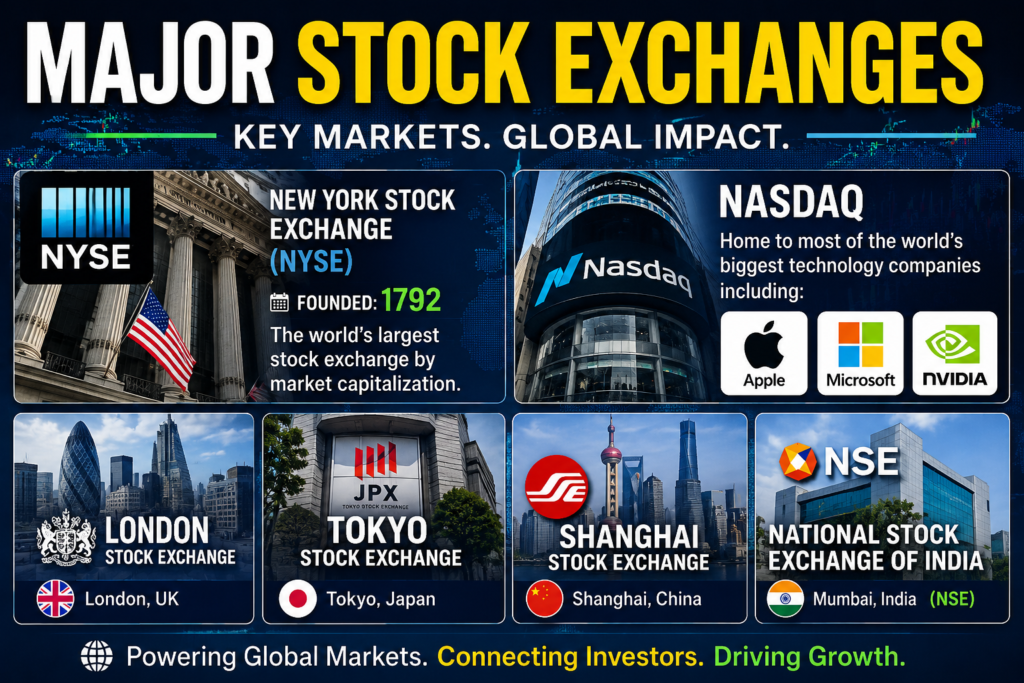
The New York Stock Exchange (NYSE), founded in 1792, is the world’s largest stock exchange by market capitalization. The NASDAQ is home to most of the world’s biggest technology companies including Apple, Microsoft, and Nvidia. Outside the US, major exchanges include the London Stock Exchange, Tokyo Stock Exchange, Shanghai Stock Exchange, and the National Stock Exchange of India.
In 2026, most trading on these exchanges occurs electronically through sophisticated matching systems that pair buy and sell orders in milliseconds. Physical trading floors still exist at NYSE for symbolic and ceremonial purposes, but the actual transaction infrastructure is entirely digital.
Stock Market Indices
Because tracking thousands of individual stocks is impractical, financial analysts and investors use market indices to measure the overall health of the market. An index is a mathematical composite that tracks the performance of a selected group of stocks.
The S&P 500 tracks 500 of the largest US companies and is considered the most important benchmark for the American stock market. The Dow Jones Industrial Average (DJIA) tracks just 30 large companies — a narrower but historically significant measure. The NASDAQ Composite is heavily weighted toward technology stocks.
When news reports say “the market was up 1% today,” they are typically referring to one of these indices.
Who Participates in the Stock Market?
Individual retail investors represent millions of ordinary people buying and selling stocks through brokerage accounts. Institutional investors — including mutual funds, pension funds, hedge funds, and insurance companies — account for the majority of daily trading volume. Market makers are firms that continuously offer to buy and sell specific stocks to provide liquidity. Central banks and sovereign wealth funds also hold equity positions in some markets.
In 2026, algorithmic trading — where computer programs automatically execute trades based on mathematical models — accounts for a significant share of daily volume on major exchanges.
How Stock Prices Are Determined
Stock prices are determined by supply and demand, but the forces that influence that supply and demand are complex. Company earnings are the most fundamental driver: a company that consistently grows profits typically sees its stock price rise over time. Investor sentiment, macroeconomic conditions, interest rates, geopolitical events, sector trends, and even social media can all affect short-term prices.
In the long run, stock prices tend to track fundamental value — the actual earnings power of the underlying business. In the short run, they can deviate significantly from fundamentals, creating both risks and opportunities for investors.
Bull and Bear Markets
A bull market refers to a prolonged period of rising stock prices — typically defined as a rise of 20% or more from recent lows. A bear market is the opposite: a sustained decline of 20% or more from recent highs. These cycles are natural and inevitable features of equity markets.
From 2009 to 2022, US equities experienced one of the longest bull markets in history, driven by low interest rates and technological innovation. 2022 brought a sharp bear market. 2023-2025 saw recovery and new highs. 2026 has brought a more volatile, uncertain environment shaped by trade policy shifts and geopolitical tensions.
Follow daily market analysis and stock market news at StockMarketRulers.com. For deeper academic understanding, Investopedia’s stock market fundamentals is an excellent free resource.
Why the Stock Market Matters Beyond Investors
Even people who never buy a single stock are affected by the stock market. Pension funds that hold retirement savings for millions of workers are heavily invested in equities. Corporate valuations affect how easily companies can raise capital to hire workers and build products. Falling stock markets reduce consumer confidence and spending, potentially tipping economies into recession.
The stock market is often described as a “leading indicator” — it tends to reflect expectations about future economic conditions rather than current ones. When markets fall sharply, they’re often pricing in anticipated economic weakness months before it shows up in official economic data.
Conclusion
The stock market is more than a ticker of numbers scrolling across a screen. It is the mechanism through which capital is allocated to productive businesses, through which ordinary people can participate in the growth of the economy, and through which the collective judgment of millions of participants continuously prices the future. Understanding how it works is the foundation of becoming a more confident, more successful investor.