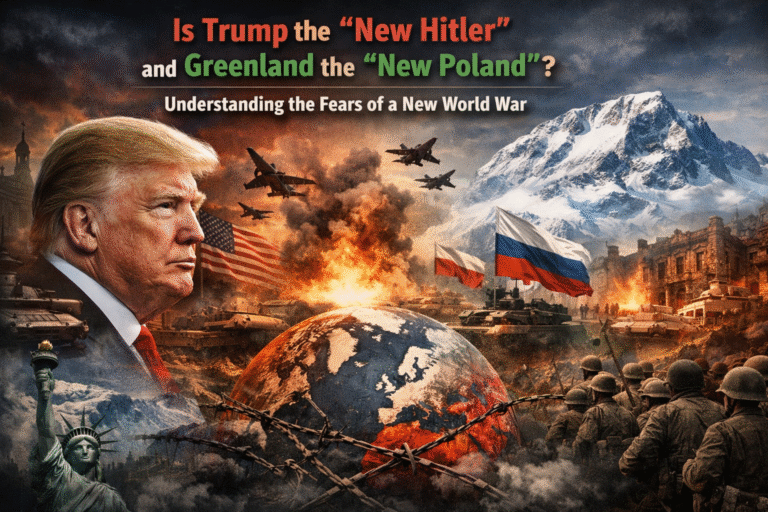
Introduction: Why This Comparison Is Raising Global Alarm
Across the United States and the wider world, a controversial narrative is gaining attention: the idea that Donald Trump is the “new Hitler” and Greenland is the “new Poland.”
This comparison does not claim historical equivalence, but rather reflects public fear, political anxiety, and historical memory resurfacing during times of global tension.
History shows that global wars rarely begin overnight. They often emerge from unchecked nationalism, territorial ambition, weakened alliances, and polarized societies. The question many are asking is simple but urgent:
Are we standing at the edge of a new world war?
Understanding the Hitler–Poland Analogy
What Happened Before World War II?
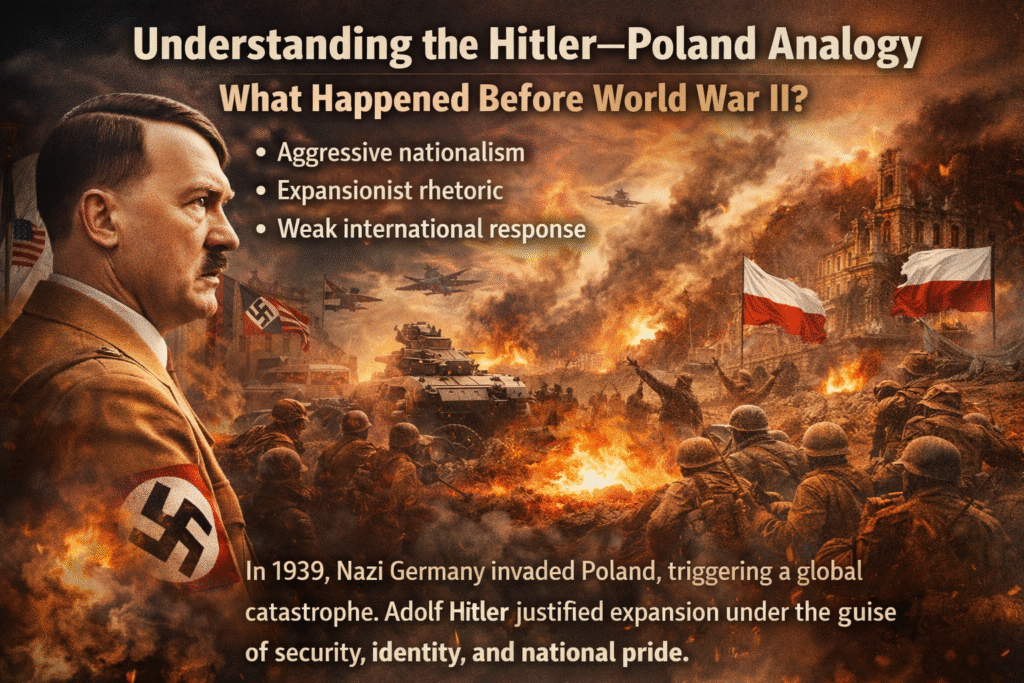
Before World War II, Europe witnessed:
- Aggressive nationalism
- Expansionist rhetoric
- Weak international response
In 1939, Nazi Germany invaded Poland, triggering a global catastrophe. Adolf Hitler justified expansion under the guise of security, identity, and national pride.
The world underestimated early warning signs.
Why Is Trump Being Compared to Hitler?
This comparison appears mostly in opinion pieces, activist circles, and social media, not academic consensus.
Key Reasons Behind the Comparison
Critics point to:
- Strong nationalist messaging
- “Us vs. them” political framing
- Skepticism toward international institutions
- Pressure on democratic norms
Supporters argue that such comparisons are unfair, exaggerated, and historically inaccurate.
Important clarification:
Trump has not pursued military conquest comparable to Nazi Germany. The analogy reflects fear of authoritarian tendencies, not identical actions.
Why Greenland Is Central to the Debate
Greenland’s Strategic Importance
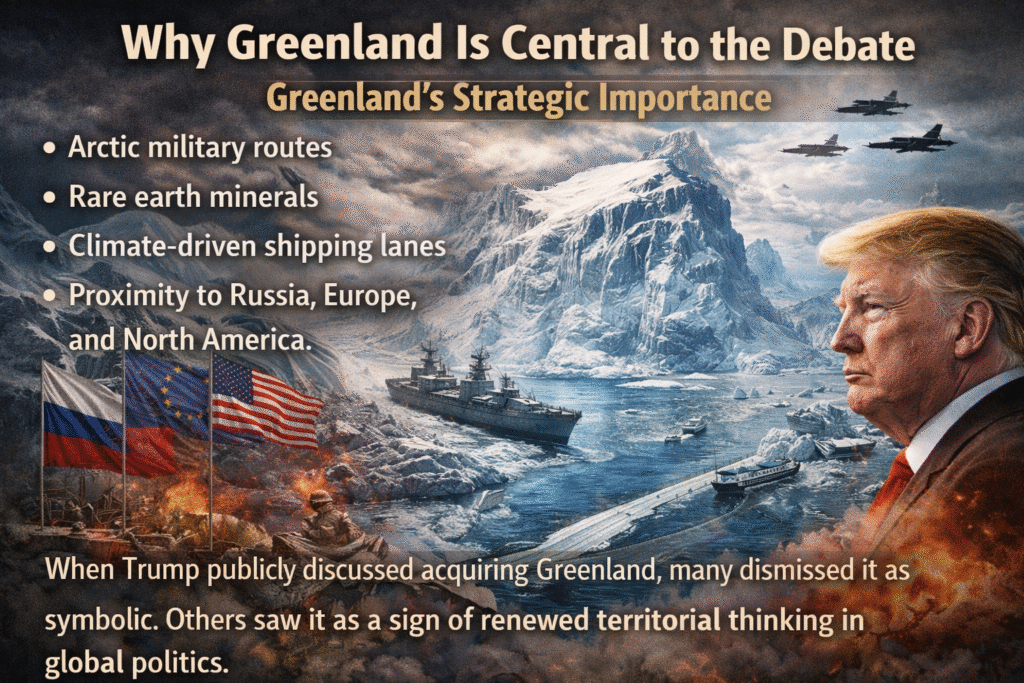
Greenland has become geopolitically critical due to:
- Arctic military routes
- Rare earth minerals
- Climate-driven shipping lanes
- Proximity to Russia, Europe, and North America
When Trump publicly discussed acquiring Greenland, many dismissed it as symbolic. Others saw it as a sign of renewed territorial thinking in global politics.
Is the World Really on the Brink of a New World War?
Similarities That Concern Analysts
- Rising nationalism worldwide
- Weakening trust in global institutions
- Great-power competition (US, China, Russia)
- Information warfare and cyber conflicts
Key Differences From the 1930s
- Nuclear deterrence
- Global economic interdependence
- Stronger (though strained) international alliances
- Instant global media scrutiny
These differences make a full-scale world war less likely—but not impossible.
Media, Fear, and the Power of Historical Memory
Historical analogies are powerful because they simplify complex fears. Calling Trump “Hitler” or Greenland “Poland” is less about accuracy and more about warning the world:
“Pay attention before it’s too late.”
Such comparisons spread quickly in an age of social media, often amplifying fear rather than encouraging informed debate.
What Should the World Actually Be Watching?
Instead of focusing on dramatic labels, global citizens should watch:
- Democratic stability
- Respect for international law
- Diplomatic conflict resolution
- Economic cooperation
- Responsible leadership
History teaches us that complacency is dangerous, but so is panic without facts.
Conclusion: A Warning, Not a Prediction
The idea that Trump is the new Hitler and Greenland is the new Poland should be understood as a symbolic warning, not a literal forecast.
It reflects:
- Global anxiety
- Fear of repeating historical mistakes
- A call for vigilance, not hysteria
The future depends not on comparisons—but on choices made today by leaders and citizens alike.
FAQ –
Is Donald Trump really comparable to Adolf Hitler?
No. The comparison is metaphorical and reflects political concerns, not historical equivalence.
Why is Greenland important to US national security?
Greenland’s Arctic location, military relevance, and natural resources make it strategically critical.
Is the world heading toward World War III?
A global war is unlikely, but geopolitical tensions and regional conflicts are rising.
Why do World War II comparisons keep resurfacing?
They serve as warnings during times of political instability and global uncertainty.
What should US citizens watch closely?
Democratic stability, foreign policy decisions, and international cooperation.