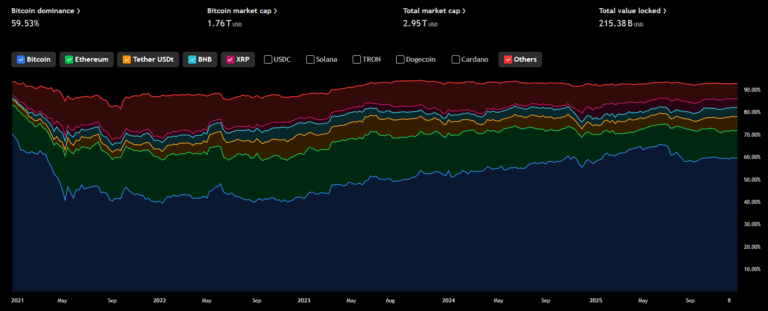
The cryptocurrency market is once again at a turning point. While price movements often steal the spotlight, this time the real story lies deeper in the data—Bitcoin dominance. With Bitcoin’s dominance climbing close to 59.53%, investors are paying close attention to what this means for the broader crypto ecosystem. This rise reflects not just Bitcoin’s strength, but also shifting investor psychology, growing caution, and changing capital flows within the market. From institutional confidence to altcoin performance, Bitcoin’s growing share of the total market cap is reshaping the future of crypto investing in powerful ways.
Understanding Bitcoin Dominance: A Mirror of Market Sentiment

Bitcoin dominance represents the percentage of the total cryptocurrency market capitalization that belongs to Bitcoin alone. At present, the total crypto market cap stands around $2.95 trillion, while Bitcoin accounts for approximately $1.76 trillion of that value. This concentration of capital highlights Bitcoin’s continued leadership role in the digital asset space.
Historically, rising Bitcoin dominance has often been associated with periods of market uncertainty or consolidation. When investors feel cautious, they tend to move funds away from smaller, more volatile altcoins and into Bitcoin, which is perceived as relatively stable and reliable. Over the years, Bitcoin has earned the reputation of being the safest crypto asset, supported by its decentralized network, strong security, and widespread adoption.
From 2021 onward, global macroeconomic pressures such as inflation concerns, interest rate hikes, and regulatory scrutiny have pushed investors toward lower-risk assets within crypto. Bitcoin dominance, therefore, acts as a powerful indicator of investor confidence and overall market mood. When dominance rises, it signals risk aversion; when it falls, it often suggests renewed appetite for altcoins and innovation-driven projects.
Why Is the Market Leaning Toward Bitcoin?
There are several strong reasons behind Bitcoin’s growing dominance. The first and most important factor is trust. Bitcoin is no longer viewed merely as a speculative digital currency; it is increasingly seen as a store of value, often referred to as “digital gold.” This perception has strengthened over time, especially during periods of economic uncertainty.
Another major driver is institutional adoption. Large investment firms, exchange-traded funds (ETFs), and corporate treasuries are allocating capital primarily to Bitcoin rather than altcoins. Institutions prefer assets with high liquidity, transparent market structures, and long-term resilience—qualities Bitcoin offers more convincingly than most alternatives.
Additionally, the altcoin market has become extremely crowded. Thousands of new tokens and projects enter the market each year, diluting capital and attention. While innovation continues, not all projects survive or deliver on their promises. As a result, investors often retreat to Bitcoin during uncertain phases, reinforcing its dominance.
Supply dynamics also play a role. Bitcoin’s fixed supply of 21 million coins creates scarcity, which strengthens its value proposition. In contrast, many altcoins have inflationary token models or unclear supply mechanisms, making them less attractive during cautious market conditions.
Altcoins Under Pressure: Decline or Consolidation?
The rise in Bitcoin dominance naturally raises concerns for altcoin investors. When Bitcoin captures a larger share of the market, altcoins often struggle to outperform. However, this does not necessarily mean the end for altcoins. Instead, it may signal a phase of consolidation and selection.
Strong altcoin projects with real-world use cases, active development, and solid communities tend to survive these periods. Ethereum, for example, continues to hold a significant portion of the market due to its role in decentralized finance (DeFi), NFTs, and smart contracts. Similarly, select layer-1 and infrastructure projects maintain relevance despite Bitcoin’s growing dominance.
On the other hand, speculative and low-utility tokens often lose momentum when capital flows tighten. This market behavior encourages maturity and filters out weaker projects. Historically, after periods of high Bitcoin dominance, the market has often seen an “altcoin season,” where confidence returns and capital rotates into high-quality altcoins.
For investors, this phase demands patience and research. Blind speculation becomes risky, while long-term conviction in fundamentally strong projects can offer meaningful opportunities once the market balance shifts again.
DeFi, Stablecoins, and Market Liquidity
Beyond Bitcoin and altcoins, other market indicators also offer valuable insights. The current Total Value Locked (TVL) in DeFi stands at approximately $215.38 billion, reflecting ongoing engagement with decentralized applications despite market fluctuations. While this figure is below previous all-time highs, it shows that DeFi remains an essential pillar of the crypto ecosystem.
Stablecoins such as USDT and USDC continue to play a crucial role in maintaining liquidity. During periods of rising Bitcoin dominance, stablecoin usage often increases as investors park funds on the sidelines, waiting for clearer market direction. This behavior suggests that capital is not leaving crypto entirely but is instead being repositioned strategically.
These dynamics highlight a more mature market structure, where investors actively manage risk rather than chasing short-term hype. Bitcoin’s dominance, in this context, acts as an anchor, stabilizing the broader ecosystem during transitional phases.
What This Means for Retail and Long-Term Investors
For retail investors, rising Bitcoin dominance can feel discouraging, especially for those heavily invested in altcoins. However, it also presents an opportunity to reassess strategies. Bitcoin’s strength offers a defensive position, while selective exposure to high-quality altcoins can prepare investors for future growth cycles.
Long-term investors often view periods of high dominance as accumulation phases. Historically, Bitcoin-led markets have laid the foundation for the next wave of innovation and altcoin rallies. The key lies in understanding market cycles rather than reacting emotionally to short-term trends.
Education, diversification, and disciplined risk management become especially important during such phases. Investors who align their portfolios with market realities are better positioned to benefit when sentiment shifts and broader participation returns.
The Road Ahead: Is Bitcoin Dominance Here to Stay?
Looking forward, the big question remains: will Bitcoin dominance continue to rise, or is a reversal on the horizon? Much depends on macroeconomic conditions, regulatory clarity, and technological advancements within the crypto space.
If global uncertainty persists, Bitcoin may continue to attract capital as a safe haven. However, breakthroughs in scalability, regulation, or real-world adoption could reignite interest in altcoins, gradually reducing Bitcoin’s share. Market history suggests that dominance moves in cycles rather than straight lines.
What is clear is that Bitcoin’s role as the backbone of the crypto market is stronger than ever. Its dominance reflects confidence, maturity, and resilience—qualities that shape the future direction of digital assets as a whole.
A Market Growing Up
Bitcoin dominance nearing 60% is not just a statistic—it is a story of a market growing up. It reflects cautious optimism, smarter capital allocation, and a shift from speculation to sustainability. While altcoins may face challenges in the short term, innovation remains alive beneath the surface. For investors, this phase is a reminder that understanding market structure is just as important as tracking prices. The crypto market continues to evolve, and Bitcoin remains firmly at its core.
Disclaimer
This article is for informational and educational purposes only. It does not constitute financial or investment advice. Cryptocurrency markets are highly volatile, and investors should conduct their own research or consult a qualified financial advisor before making any investment decisions.