In the rapidly evolving landscape of global diplomacy, India finds itself at a critical crossroads, balancing complex relationships with the United States, Iran, and Russia. Recent developments, ranging from naval access in the Strait of Hormuz to strategic warnings at the Raisina Dialogue, highlight the delicate tightrope act the Modi government must perform to safeguard national interests. This article explores the latest updates in international relations and what they mean for India’s economic and strategic future.
The Strait of Hormuz: Iran’s Strategic Message to India
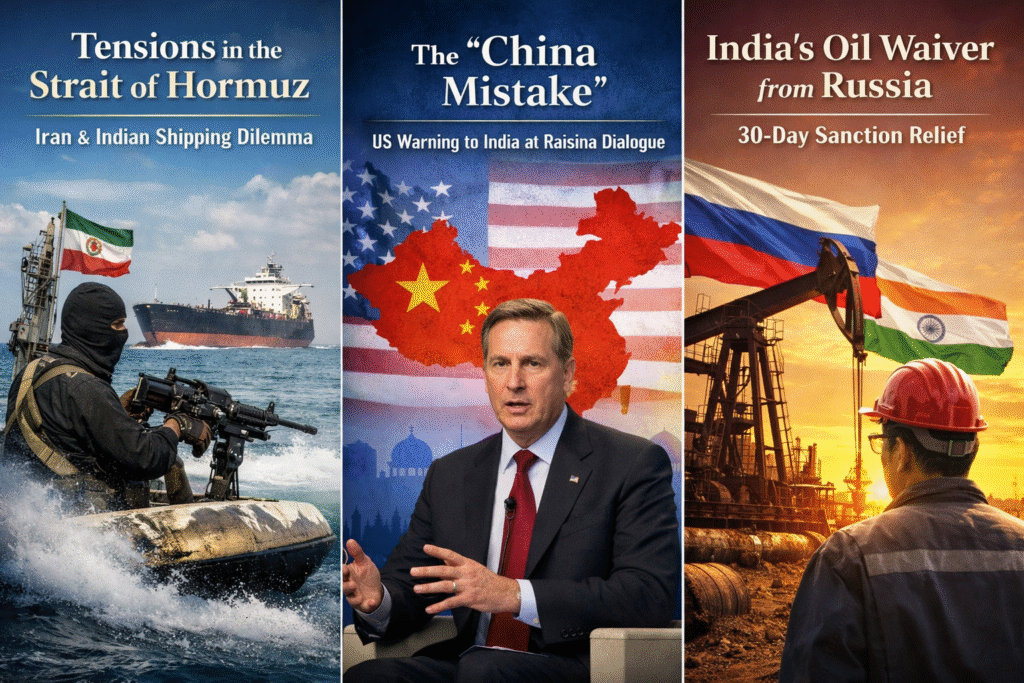
The Strait of Hormuz is arguably the most vital maritime “choke point” for India’s energy security. Historically, approximately 40% of India’s daily oil and gas imports cross through this narrow passage. However, recent escalations have seen the Iran Revolutionary Guards (IRGC) targeting ships in this region.
In a significant move, Iran has announced that it will not block Indian ships from passing through the Strait of Hormuz. The IRGC clarified that the passage is only closed to the United States, Israel, European countries, and their allies. While this appears to be a major relief for New Delhi, there is a significant logistical catch.
The Shipping Dilemma
Despite the waiver, India faces a hurdle: the global shipping industry. India has very few Indian-flagged or Indian-owned shipping companies, and lacks large oil tanker ships of its own. Most of the crude oil India imports arrives on tankers owned by foreign countries. Therefore, even though the oil belongs to India, the ship carrying it might still be a target for Iranian forces if it belongs to a country on Iran’s “restricted” list. This complexity has already resulted in the loss of five Indian crew members in recent Iranian attacks on tankers, a matter for which Iran has yet to offer a formal explanation.
The “China Mistake”: A New Directive in US-India Ties
One of the most profound statements regarding the future of Indo-US relations recently came from the Raisina Dialogue, India’s premier international think-tank platform. Organized by the Ministry of External Affairs in collaboration with the Observer Research Foundation (ORF), this platform serves as a barometer for global geopolitical trends.
At this event, US Deputy Secretary of State Christopher Lando sent a blunt message to New Delhi: the United States will not repeat the “mistake” it made with China two decades ago.
Lessons from the 1990s
Lando explained that in the 1990s, the US provided China with easy and open access to its markets, leading to massive technology transfers, investments, and the shifting of manufacturing bases to China. At the time, Washington believed that integrating China into the global trade system would lead to political reforms and cooperation. Instead, China utilized these economic benefits and advanced production techniques to become a global manufacturing power that now challenges US dominance.
The New US Stance Toward India
Lando emphasized that the US has learned its lesson and will no longer grant “blind” or “easy” access to US technology and markets. This means:
- Protection of Sensitive Technology: Advanced and sensitive technology transfers to India will be strictly protected or limited.
- Fair Trade Deals: The US will not sign one-sided trade deals where the “balance is too heavy” in India’s favor.
- Potential Restrictions: There is a possibility that the US may eventually impose restrictions on India similar to those currently faced by China to protect its own commercial interests.
While Lando noted that “America First” does not mean “America Alone,” he made it clear that cooperation with partners like India must align with US economic and strategic goals.
The 30-Day Russian Oil Waiver: A Strategic Necessity
In another major development, the US Treasury Department has granted India a temporary 30-day sanction waiver to purchase Russian crude oil. This move is intended to ensure that global oil supplies remain stable amid the pressures caused by Iranian actions in the Middle East.
Who Benefits from the Waiver?
While the Indian government and state-run refineries have continued to purchase Russian oil in reduced quantities throughout the conflict, private entities like Reliance Industries had been strictly following US sanctions. This new 30-day window allows private refiners and Reliance to resume large-scale purchases of Russian crude.
Interestingly, reports suggest that Reliance Industries recently hired a lobbying firm in Washington, and this waiver may be a result of pressure applied to the Donald Trump administration. The US has framed this as a short-term measure, primarily allowing for the transaction of oil that is already stuck on ships at sea.
The Shift to Venezuela and the US
The US expectation is that India will eventually increase its oil purchases from the United States. Furthermore, the waiver is limited to 30 days because Venezuelan crude oil is expected to start reaching Indian shores by next month. If the conflict in the Middle East persists, there is a possibility that this waiver could be extended.
Ukraine’s Role in Middle East Defense
In an unexpected turn, the US has sought assistance from Ukraine to counter Iranian-made Shahed drones in the Middle East. Ukrainian President Volodymyr Zelensky revealed that the US requested their help due to Ukraine’s extensive experience in “drone warfare”.
The Expertise of Modern Warfare
Over the last few years, Russia has used Iranian Shahed-131 and Shahed-136 “kamikaze” drones to target Ukrainian cities and infrastructure. Consequently, Ukraine has developed:
- Advanced detection and interception techniques.
- Inexpensive “interceptor drones” that destroy Shahed drones mid-air through collision.
The US wants to leverage this “battle experience” because using expensive missiles to shoot down cheap drones is not a sustainable financial strategy. The techniques shared by Ukraine will likely be used by the US to protect interests in the Middle East against Iranian drone threats.
Conclusion: India’s Strategic Path Forward
The current geopolitical climate is one of rapid shifts and “blackmailing” where every nation is attempting to secure its own interests. For India, the challenges are manifold:
- Navigating Energy Security: Utilizing waivers from both Iran and the US while dealing with the lack of a domestic shipping fleet.
- Managing US Expectations: Building a strategic partnership with Washington while acknowledging that the US is now more protective of its technology than ever before.
- Balancing Old and New Allies: Maintaining ties with Russia for affordable energy while coordinating with the US on global market stability.
As the Modi government continues to refine its foreign policy, the goal remains clear: to ensure India does not fall behind in a world where global alliances are being rewritten every 24 hours. Authenticity, data-driven analysis, and a clear-eyed view of national interest will be the keys to India’s success in this “new world order”