Introduction
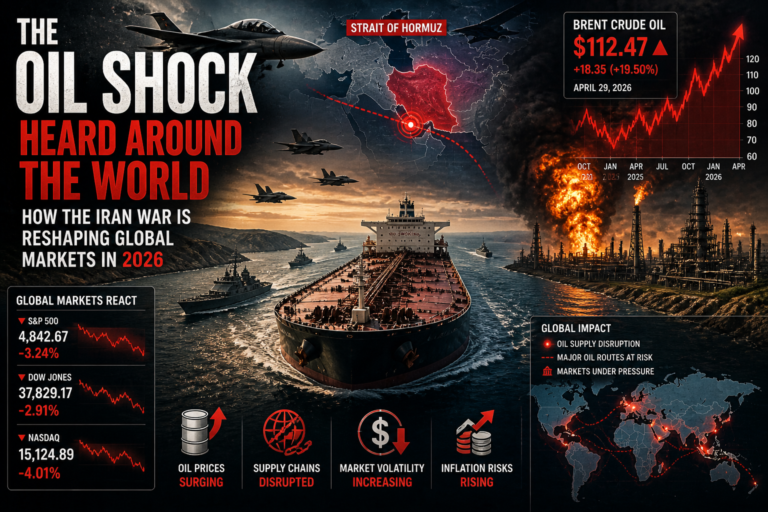
On March 1, 2026, the world changed. US and Israeli military strikes on Iran triggered what the International Energy Agency would later describe as the “greatest global energy security challenge in history.” Brent crude — the international oil benchmark — surged from roughly $72 a barrel to nearly $120 at its peak, a gain of more than 55% in weeks. March alone saw a 51% monthly jump in crude prices, one of the largest single-month surges ever recorded.
The Strait of Hormuz, the narrow waterway through which roughly 20% of the world’s seaborne oil flows every single day, became the most closely watched chokepoint on the planet. Its effective closure sent shockwaves through energy markets, supply chains, and central bank boardrooms from Washington to Tokyo.
For investors, the Iran war represents the largest geopolitical oil shock since the 1973 OPEC embargo — and its ripples are still spreading.
The Anatomy of the Shock
The Strait of Hormuz: The World’s Most Critical Oil Chokepoint
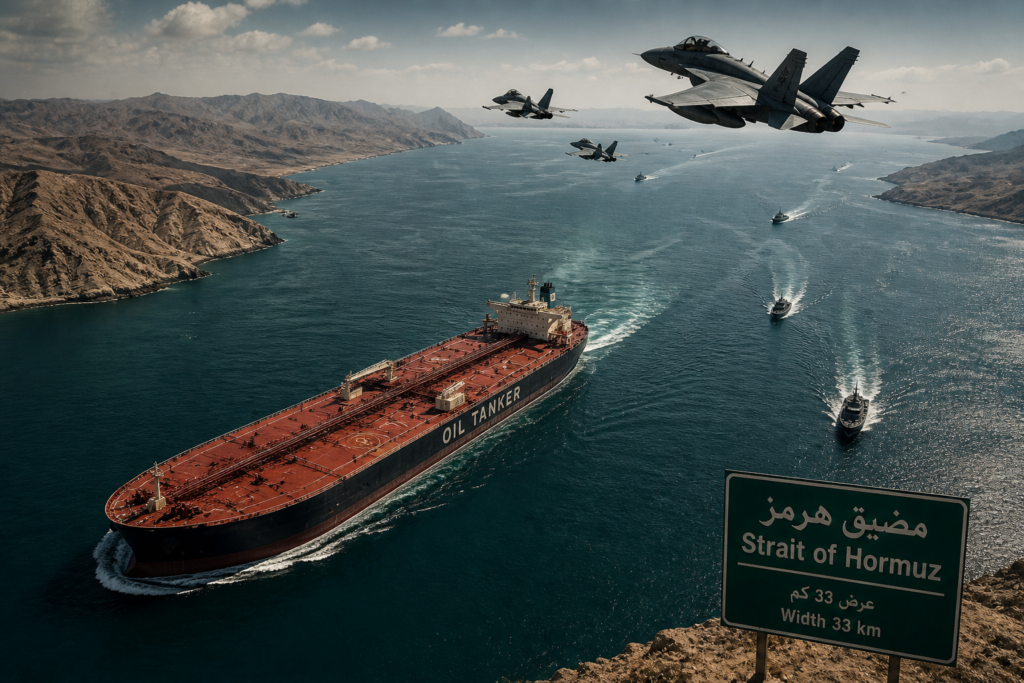
The US Energy Information Administration has long called the Strait of Hormuz a “critical oil chokepoint.” Under normal conditions, approximately 20 million barrels of oil flow through it daily — roughly one-fifth of global production. Iran controls the strait’s northern coast, and its ability to threaten or restrict traffic gave Tehran enormous geopolitical leverage even before the war.
When military operations began, traffic through the strait collapsed dramatically. By early April, shipments averaged just 3.8 million barrels per day — a fraction of the pre-war 20+ million barrels. Saudi Arabia, the UAE, and Iraq scrambled to route exports through alternative pipelines, bringing alternative-route flows to 7.2 million barrels per day from under 4 million before the war. But the gap remained enormous.
The IEA’s April Oil Market Report revised global oil demand forecasts sharply downward — projecting a contraction of 80,000 barrels per day in 2026, against prior expectations of 730,000 barrels per day of growth. The reversal, a swing of over 800,000 barrels per day in the forecast, represents a seismic shift in the demand picture driven purely by geopolitical disruption.
The LNG Crisis: Qatar in the Crossfire
The war’s energy disruption extended beyond crude oil. On March 18, Iran struck Qatar’s Ras Laffan Industrial City LNG complex — one of the world’s most important natural gas export hubs — reducing Qatar’s LNG production capacity by approximately 17%. The damage was estimated to require three to five years to fully repair.
LNG spot prices in Asia responded immediately, surging more than 140%. Given that Asia accounts for roughly 84% of the crude oil and 83% of the LNG that ordinarily passes through the Strait of Hormuz, the impact on major Asian economies was severe and immediate.
Country-by-Country Impact
United States: Buffered, But Not Immune
America’s robust domestic production — the legacy of the shale revolution — provided significant insulation. But insulation is not immunity. US gasoline prices rose sharply from the start of the conflict, reaching $4 per gallon by late March. The consumer-facing inflation impact directly complicated the Federal Reserve’s monetary policy calculus, contributing to the FOMC’s decision to hold rates steady through the spring.
Defense stocks — Northrop Grumman, Lockheed Martin, Raytheon — surged on war premium as military contracts expanded. Energy majors ExxonMobil and Chevron both exceeded Q1 earnings expectations, benefiting from higher realized prices even as their shares remained somewhat muted on ceasefire speculation.
Asia: The Epicenter of Energy Vulnerability
Japan, which sourced 94.2% of its crude oil imports from the Middle East as of February 2026, was among the most exposed major economies. Tokyo responded by releasing 80 million barrels from strategic reserves — equivalent to 15 days of domestic demand — beginning March 16.
China, which routes approximately 70% of its Gulf oil through the Strait, faced acute supply disruption. Beijing’s response was multipronged: strategic reserve releases, alternative sourcing from Russia and West Africa, and diplomatic maneuvering to position China as a potential mediator in the conflict.
India, Pakistan, Bangladesh, and Vietnam faced perhaps the most severe near-term pain, given their heavy import dependence and limited strategic reserves.
Europe: Energy Transition Gets a New Urgency
Europe, which had already undergone a painful energy transition following Russia’s Ukraine war, faced renewed pressure. UK supermarket Asda warned of fuel shortages. The political debate over North Sea production and the Energy Profits Levy was reignited. Perhaps most significantly, the Iran war provided the clearest possible demonstration that renewable energy — solar and wind — offers a form of energy security that fossil fuel dependence cannot match.
Market Correlations: Stocks, Gold, and the Commodity Complex
The Iran war produced clear winners and losers in financial markets:
Winners: Energy stocks (supermajors and independents), defense contractors, gold (classic safe-haven), US domestic energy infrastructure.
Losers: Airlines (jet fuel costs), shipping companies (insurance premiums and route diversions), consumer discretionary (spending squeezed by gasoline), and emerging market equities dependent on cheap energy imports.
Gold’s performance was particularly notable. The metal, historically a safe haven in geopolitical crises, attracted strong buying as investors sought protection against both inflation and geopolitical uncertainty. The Iran war simultaneously boosted gold’s inflation-hedge appeal and its geopolitical-hedge appeal — a rare double-driver.
The Path Forward: Three Scenarios
Scenario 1 — Ceasefire and Gradual Normalization: Negotiations in Islamabad between US envoys and Iranian counterparts lead to a formal ceasefire and gradual reopening of the Strait. Brent crude retreats to the $80–$90 range. Inflation pressures ease modestly but do not disappear given lingering infrastructure damage. This is the market’s base case.
Scenario 2 — Prolonged Stalemate: Negotiations collapse, the Strait remains impaired, and Brent crude tests $100 again. Global inflation re-accelerates. The Fed faces a genuine stagflation risk. Equity markets reprice downward, especially rate-sensitive and energy-cost-sensitive sectors.
Scenario 3 — Escalation: Attacks on Saudi or UAE infrastructure knock major production offline. Brent crude spikes past $150. A global recession becomes a base case rather than a tail risk.
Commodity Context founder Rory Johnston argues that even in the optimistic scenario, relief would be temporary — supply chain bottlenecks, infrastructure damage, and lingering production outages would likely anchor Brent in the $80–$90 range, not at pre-crisis levels. “This is still the largest oil supply shock in the history of the oil market,” Johnston has noted.
Conclusion: Repricing Risk in a Post-Hormuz World
The Iran war has permanently altered the calculus of global energy security. It has demonstrated, with brutal clarity, just how dependent the global economy remains on a narrow strip of water between Iran and Oman. It has accelerated the case for energy diversification, renewable investment, and strategic reserve adequacy. And it has injected into central bank models a new inflationary variable that no amount of monetary policy can fully neutralize.
For investors, the critical insight is this: the age of cheap, predictable energy is over for the foreseeable future. Portfolios need exposure to domestic energy producers, energy infrastructure, and the renewable transition — not because it is fashionable, but because the alternative has become intolerably risky.
The Fed’s Frozen Rate Policy: Why Jerome Powell’s Final Meeting Left Markets Bracing for the Unknown