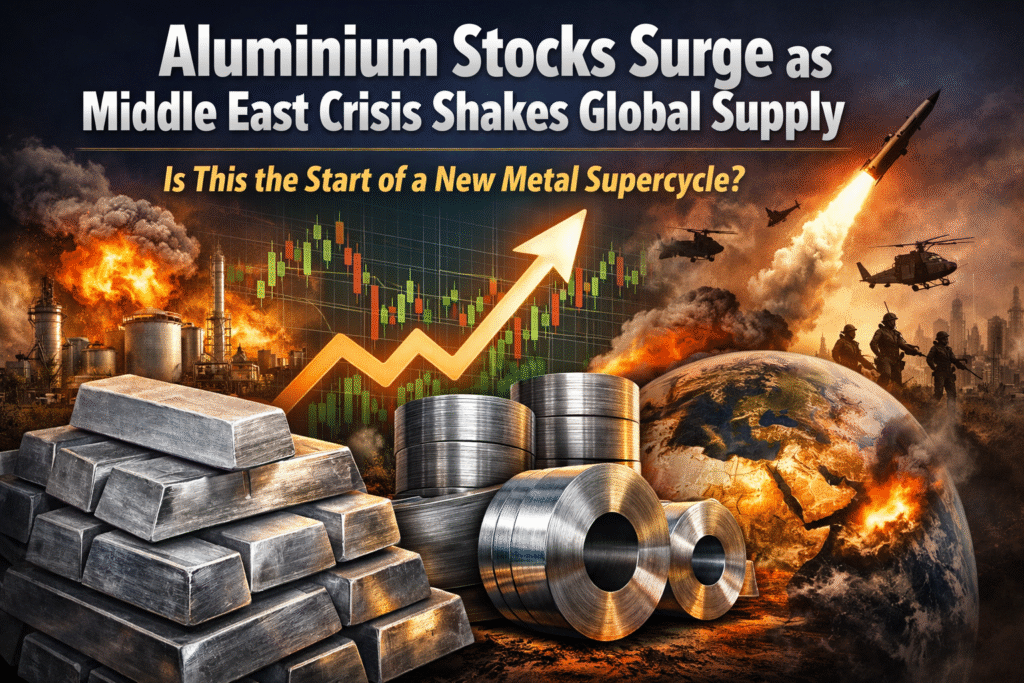
While the broader market on Dalal Street felt like a bloodbath this Monday, a surprising pocket of resilience emerged in the metals space. As the BSE Sensex plummeted over 1.2%, nearly wiping out 1,000 points in early trade, aluminium stocks like Hindalco Industries, National Aluminium Company (NALCO), and Vedanta decoupled from the benchmark to post staggering gains.
The trigger wasn’t a domestic policy shift or a surprise earnings beat. Instead, the “shining” performance was fueled by fire and smoke in the Middle East. Over the weekend, reports surfaced of missile and drone strikes hitting major production hubs in the Gulf, sending the London Metal Exchange (LME) into a frenzy. For Indian investors, this isn’t just another day of volatility; it’s a fundamental shift in the global supply-demand equation that could redefine the sector’s outlook for 2026.
The Global Supply Shock: Why Aluminium is Catching Fire
The primary catalyst for this sudden rally is a massive supply disruption in the Gulf region, which accounts for roughly 9% of the world’s aluminium supply. Tensions between the US, Israel, and Iran reached a breaking point following strikes that resulted in significant damage to two of the world’s most critical smelting facilities: Aluminium Bahrain (Alba) and Emirates Global Aluminium (EGA).
Alba, which operates the world’s largest single-site smelter, confirmed it is currently assessing damage from Iranian strikes. Meanwhile, EGA reported its plant sustained “significant damage”. The result? Benchmark three-month aluminium on the LME jumped 6% to hit near four-year highs, trading at roughly $3,492 per metric tonne.
Compounding the facility damage is the growing “chokehold” on the Strait of Hormuz. This critical shipping lane is now fraught with uncertainty, making it nearly impossible for producers in the region to move material to global markets. When you combine physical plant damage with a logistical nightmare, you get a classic supply-side shock.
Stock Overview: The Titans of Indian Metal
To understand why Indian players are the biggest beneficiaries, we have to look at their market positioning.
- Hindalco Industries: A flagship of the Aditya Birla Group, Hindalco is a global powerhouse, particularly through its subsidiary Novelis. While it has seen a 4.46% decline over the past month due to general market weakness, its long-term trajectory remains formidable, with a 10-year return of over 920%.
- NALCO: As a state-owned enterprise (PSU), NALCO is one of the lowest-cost producers of alumina and aluminium globally. Its integrated operations give it a massive cushion when global prices spike.
- Vedanta: Anil Agarwal’s diversified natural resources giant has been in the news for its potential demerger, but today, its aluminium segment is the star of the show, benefiting directly from the LME price surge.
Market Reaction: Defying the Sensex Slump
The intraday price action on March 30, 2026, was nothing short of dramatic. While the Nifty 50 struggled to hold the 22,500 mark, the Nifty Metal index was the only sectoral index trading in the green.
- NALCO emerged as the leader, surging over 6% to trade near Rs 395.
- Hindalco Industries bucked the trend of its large-cap peers, rallying 5% to hit an intraday high of approximately Rs 913.
- Vedanta wasn’t far behind, gaining around 5% to reach Rs 679 per share.
Investors are clearly rotating capital out of high-beta sectors and into “commodity plays” that offer a hedge against geopolitical instability. The volume activity in these counters was significantly higher than their 20-day averages, suggesting that institutional “big fish” are moving back into the metal space.
Expert Insights: The Bull vs. Bear Debate
The current rally has split the analyst community. Some see this as a temporary “war bounce,” while others believe a structural supply deficit is forming.
The Bull Case: Many seasoned analysts point out that even if the conflict eases, restoring damaged infrastructure in the Middle East won’t happen overnight. “You don’t just flip a switch on an aluminium smelter once it’s been damaged or powered down,” says one market veteran. Furthermore, the Union Budget 2026-27 has allocated a record Rs 7.85 lakh crore to Defence, with a heavy emphasis on “Aatmanirbhar Bharat” (self-reliance). Since aluminium is a “strategic metal” used extensively in aerospace and military hardware, domestic demand is essentially guaranteed.
The Bear Case: However, firms like JM Financial are waving a yellow flag. They argue that while supply is tightening, global demand momentum is actually weakening. High interest rates and a slowing global economy could mean that consumers of the metal—like the auto and construction sectors—might pull back if prices stay above $3,500 for too long. They suggest that the “balance is shifting,” and the rally might see a “mean reversion” in the second half of the fiscal year as other regions ramp up supply to fill the gap.
Financial Analysis: Growth Amid Volatility
Looking at the numbers, the Indian aluminium sector has been through a period of “healthy but stressed” growth.
- Hindalco’s long-term fundamentals are strong, with net sales growing at an annual rate of 16.72% and operating profit at 21.50%. However, its most recent quarterly PAT (Profit After Tax) fell by 12.1% compared to its previous four-quarter average, standing at Rs 3,939.38 crore. This makes the current price spike even more critical for margin recovery.
- Cost Efficiency: One of the biggest advantages for Indian firms right now is their relatively low debt. Hindalco, for instance, maintains a debt-to-equity ratio of 0.48 times, which is quite lean for a capital-intensive sector.
- The Alumina Factor: While energy costs (LPG/LNG) are rising, an emerging surplus in alumina—the raw material for aluminium—is helping to ease input pressure for domestic smelters.
Future Outlook: The EV and Defence Triggers
Beyond the immediate war in the Middle East, aluminium has two massive “secular” tailwinds:
- Electric Vehicles (EVs): As India pushes for greener transport, aluminium’s role is non-negotiable. It is used in solar panels, battery casings, and lightweight components to extend EV range.
- Strategic Infrastructure: The government’s focus on the Border Roads Organisation (BRO), with an allocation of Rs 7,394 crore, and massive projects in bridges and airfields, will continue to act as a floor for metal demand.
In the short term (3–6 months), the Strait of Hormuz remains the key variable. If shipping remains blocked, we could see LME prices testing the $4,000 mark. In the long term, the recovery of European operations (as seen in the Tata Steel model) and domestic capacity expansion will be the real drivers of shareholder value.
Should You Buy, Hold, or Sell?
Deciding your next move depends entirely on your time horizon.
- For the Tactical Trader: The momentum is clearly bullish. The fact that Hindalco is trading above its 100-day and 200-day moving averages suggests that the “path of least resistance” is currently up.
- For the Long-term Investor: Metal stocks are notoriously cyclical. If you are buying now, you are buying near a four-year price high. However, the valuation for a company like Hindalco remains “attractive” with an EV/Capital Employed of 1.3.
- The Verdict: If you already hold these stocks, Holding seems the most logical path to capture the full extent of the supply shock. New buyers might want to wait for a “cool-off” or a minor correction before jumping in, as the market is currently reacting to headlines that change by the hour.
A Final Word from the Trading Floor
The rally in aluminium shares is a stark reminder that in a globalized economy, a drone strike thousands of miles away can dictate the fortune of an Indian portfolio. While the Middle East supply shock has provided a massive tailwind for NALCO, Hindalco, and Vedanta, the underlying story is one of Indian metal resilience.
As Dalal Street waits for the next update from the Gulf, one thing is certain: aluminium is no longer “just another industrial metal”—it has become a strategic asset in an increasingly uncertain world.