Introduction
For three years, the so-called Magnificent Seven — Apple, Microsoft, Alphabet, Amazon, Meta, Nvidia, and Tesla — have been the undisputed engine of US equity market performance. They collectively account for roughly one-third of the S&P 500’s average performance and have driven the lion’s share of index returns in the AI era.
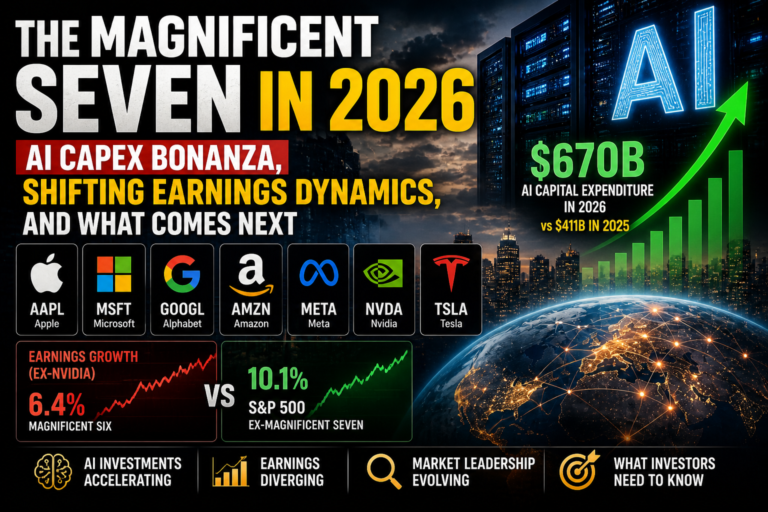
But in 2026, the narrative is shifting. For the first time since the AI boom ignited, the math is turning against the mega-cap tech titans in a critical way: with Nvidia stripped out of the calculation, the remaining six Magnificent Seven companies are growing earnings at just 6.4% this quarter — less than the 10.1% posted by the other 493 companies in the S&P 500. The era of unchallenged Magnificent Seven earnings dominance may be giving way to something more nuanced.
Yet the money they are pouring into AI infrastructure is breathtaking. Combined 2026 AI capital expenditure for the five who have reported is projected at $649 billion, against $411 billion in 2025. This is not a pivot — it is an acceleration. Whether those investments will generate commensurate returns is the defining question for equity markets in the second half of 2026.
Company-by-Company Breakdownidia: The Undisputed AI Champion
Nvidia remains in a category of its own. The company reported Q4 FY2026 revenue of $68.13 billion, up an extraordinary 73% year-over-year, with non-GAAP earnings per share of $1.62 beating consensus by $0.10. Management guided Q1 FY2027 revenue to approximately $78 billion, maintaining gross margins near 75%.
The supply commitments that underpin this guidance are staggering: locked-in orders include at least 10 gigawatts of systems with OpenAI, an initial 1 gigawatt with Anthropic, a multiyear deal with Meta covering millions of Blackwell and Rubin GPUs, and 5+ gigawatts of AI factories with CoreWeave through 2030. Total supply commitments stand at $95.2 billion.
Nvidia’s market cap climbed to approximately $5.2 trillion in late April 2026, briefly jockeying with Alphabet for the title of world’s most valuable company. The Blackwell Ultra chip architecture and the forthcoming Rubin platform — each delivering exponential performance gains for agentic AI workloads — continue to expand what CEO Jensen Huang describes as an “agentic AI inflection point.”
The one genuine risk: China. Q1 FY2027 guidance explicitly assumes zero data center compute revenue from China due to export restrictions. That is a meaningful and growing hole in the revenue mix.
Apple: Resilience in the Face of iPhone Softness
Apple’s fiscal Q2 earnings report was the catalyst that powered the S&P 500 and Nasdaq to fresh records on May 1. The company posted a revenue beat and a better-than-expected outlook for the current quarter — impressive given the macro backdrop.
The iPhone, however, remains a complicated story. Revenue from the device fell short of estimates for the second time in three consecutive quarters. What saved the headline numbers was robust performance in Services, continued strength in China, and sales of the newest iPhone models. Apple’s ability to grow its services revenue regardless of unit hardware cycles represents a fundamental transformation of its business model — and the market is increasingly pricing that in.
Microsoft: Azure’s 39% Growth Is the Real Story
Microsoft’s most recent quarterly results — revenue of $81.3 billion, up 17% — were headlined by Microsoft Cloud revenue crossing $50 billion for the first time, rising 26% year-over-year. But the single most important data point was Azure’s 39% revenue growth, a figure that puts Microsoft firmly in the AI infrastructure race.
CEO Satya Nadella captured it precisely: “We are only at the beginning phases of AI diffusion and already Microsoft has built an AI business that is larger than some of our biggest franchises.” Commercial remaining performance obligations — essentially Microsoft’s contracted future revenue — surged 110% to $625 billion, a number that points to sustained momentum well into 2027 and beyond.
One note of caution: Microsoft shares are down approximately 12% year-to-date, lagging Alphabet’s 30% gain and Amazon’s 13% advance. The market appears to be processing concerns that Microsoft’s heavy investment in OpenAI and AI infrastructure will compress near-term free cash flow margins even as long-term revenue potential grows.
Alphabet: Cloud and AI Vindication
Alphabet delivered what one Zacks analyst called hitting it “out of the park” in Q1 2026. Google Cloud revenue surged 63% — a genuinely stunning acceleration from the already impressive 48% growth in Q4 2025. The result settled, at least temporarily, the persistent market anxiety about whether Alphabet could monetize AI given the existential threat AI chatbots pose to its core search business.
The answer from Q1 results: yes, it can. Search, subscriptions, and Cloud all showed impressive momentum. Alphabet’s market cap crossed $4.548 trillion, placing it in direct competition with Nvidia for the title of world’s most valuable company. Over the past six months, Alphabet stock has climbed roughly 30% — the best performance among the Magnificent Seven outside of Nvidia.
Meta: The Efficiency-to-AI Pivot Deepens
Meta’s results were closely watched given the company’s dramatic transformation from “Year of Efficiency” restructuring in 2023-2024 to AI-first capital allocation in 2025-2026. The company paused its recent selloff after Q1 results demonstrated that its AI investments are generating real advertising revenue improvements.
Meta is projected to spend heavily among the hyperscalers in 2026, contributing to the collective $670 billion AI capex figure. The key question for Meta investors is whether its AI advertising optimization and its Meta AI assistant will generate sufficient return on that investment to justify the valuation.
The Capex Question: Return on Investment or a Race to the Bottom?
The combined $670 billion in planned AI capital expenditure by the major hyperscalers is equivalent to more than 90% of their expected cash flows for the year. This represents the largest corporate investment cycle in history, dwarfing even the telecom infrastructure buildout of the late 1990s.
Goldman Sachs Research identifies an AI data center construction basket that has already returned nearly 60% year-to-date. Infrastructure picks — power utilities, cooling systems, networking equipment, real estate investment trusts focused on data centers — are the “clearest investment opportunity” according to Goldman strategist Ben Snider, because they benefit from the build-out regardless of which hyperscaler ultimately wins the AI arms race.
The risk, as Snider himself acknowledges, is that until the largest companies can demonstrate accelerating revenues alongside slowing capital spending, valuations remain compressed by uncertainty about the ultimate return on all this investment.
Conclusion: A Market Defining Transition
The Magnificent Seven remain the most consequential group of companies in global financial markets. But the era of reflexive mega-cap tech outperformance is giving way to something more selective and more analytical. Nvidia is in a category unto itself, powered by structural semiconductor demand that shows no sign of abating. Alphabet is proving its AI monetization thesis. Apple is demonstrating Services resilience.
But investors who treat all seven names as a homogeneous AI trade are likely to be disappointed. The winners in the next phase will be those companies that can demonstrate a credible path from AI capital expenditure to AI revenue — and the gap between those that can and those that cannot is already beginning to widen.
The Oil Shock Heard Around the World: How the Iran War Is Reshaping Global Markets in 2026